
Hi, I’m Kyle.

About Kyle Linnemann
I am a Licensed Professional Clinical Counselor in Kentucky and Ohio. As a sixth generation member of a family of funeral directors and owners, I often thought my career path would lead me towards working with the bereaved in the funeral business. That’s right, my grandfather, his father, his father, and his father, were all funeral home owners and directors. However, my interest and passion in psychotherapy led me elsewhere.
I was driven to understand why people suffer, and how I could help as a therapist. This path led me to obtaining my Masters of Arts in Mental Health Counseling from the University of Cincinnati in 2010, and gave me the opportunity to learn how to help people struggling to cope with anxiety, phobias, obsessive compulsive disorder, depression, anger, trauma, and other emotional and behavioral struggles. I immediately identified cognitive behavioral therapy (CBT) as a treatment I wanted to utilize for these issues because it is evidence based; research repeatedly indicates it is very effective in treating mental, emotional, and behavioral challenges. I quickly realized how useful and powerful this treatment is when I learned to use it with my clients. After 13 years, I continue to be grateful for the effectiveness of these strategies and other treatments I’ve implemented, such as acceptance and commitment therapy (ACT), because I see how valuable they are to my clients.
Shortly after becoming independently licensed and beginning my own practice, my aunt and uncle, the owners of the aforementioned funeral business (Linnemann Funeral Homes), reached out to me and suggested I could use my expertise to contribute to their clients and the funeral home in their aftercare program. I couldn’t pass on this opportunity to connect with my family and their long history of service, and contribute in my own way. I jumped at the chance, and immediately threw myself into learning how to help people that are “stuck” in their grief: people who don’t feel like their grief is progressing, and struggle to experience satisfying, meaningful lives due to their loss.
Because of my emphasis in providing my clients with evidence based treatment, I discovered, and then learned, Complicated Grief Treatment (CGT). This therapy approach, developed by Dr. Katherine Shear, MD, the founder of the Center for Complicated Grief at Columbia University in New York City, has the highest evidence base of any grief therapy in the world. I have trained under the Center’s Senior Trainer, Dr. Bonnie Gorscak, Ph.D, and continue to refine my skills through learning from her and the Center for Complicated Grief at Columbia University.
If you are ready to work towards the life you want, reach out today and let’s get started.
Please be aware that communicating by text message, email, or through online forms involves some privacy risks. To help protect your confidentiality, I recommend not sharing personal health details through these channels. For sensitive concerns, feel free to call instead.
How I can help
-
Anger is a constant struggle, a battle within yourself to control the primal urge to lash out. You may find yourself saying things you don't mean, doing things you regret, and pushing away the people you love most. Yet, beneath the anger lies a well of hurt, pain, and frustration. It is these unaddressed emotions that fuel the flames, leaving you feeling consumed and exhausted. But remember, your anger does not define you. It is a part of you, but it does not control you.
With understanding, self-compassion, and the right support, you can learn to quiet the rage and find peace within yourself.
As an anger management therapist with over 13 years of experience and evidence-based tools, I'm here to be your partner in this journey. Together, we'll explore the roots of your anger, develop effective coping strategies, and ultimately, create a life where peace reigns. Don't let anger consume you anymore. Contact me today, and let's create a future where you navigate challenges gracefully and confidently, regardless of how stressful things get at home or work.
-
Anxiety isn't just a feeling; it's a thief. It steals your focus, peace, and happiness, leaving you restless and on edge. Your thoughts are constantly racing, spinning in an endless whirlwind of what-ifs and worst-case scenarios. It can be isolating, like a wall separating you from the world, making it hard to connect with others and enjoy life.
Know that you're not alone. This internal battle, this constant fight or flight response, is felt by many. Over 40 million adults in the U.S. (19.1%) have an anxiety disorder, making it one of the most common mental health struggles in the country (ADAA).
My goal is for your anxiety to no longer get in the way of you doing the things that are important to you or moving you closer to your goals. Through counseling, you'll find that anxiety interferes less and less with your day-to-day life.
Your anxiety does not define you, and it doesn't have to control you. There is hope, and there is help available.
You deserve to feel calm, to feel safe, and to feel free.
Are you ready to start living your life again without anxiety holding you back? If so, contact me today for a free consultation. I'd be more than happy to answer any questions you have about anxiety treatment and how I work.
-
Depression is a constant companion, a whisper in the back of your mind that tells you you're not enough, that you don't deserve happiness. Simple tasks become mountains, motivation is nonexistent, and even the activities you once cherished feel devoid of meaning. Like a lead weight tethered to your soul, it drags you down, leaving you feeling drained, hopeless, and utterly alone – trapped within your own mind, a silent prisoner in a world that seems to be moving on without you. But amidst the darkness, remember this – you are not alone.
Depression is a shared experience, and with the right support and tools, you can rise above the fog and rediscover joy, love, and purpose in your life.
I’ve seen firsthand how depression treatment can help people make lasting changes in their lives. Making the first step to get help can be scary, but I promise you, it’s worth it.
-
The familiar comfort of your life has been abruptly interrupted. Whether it's the silence where laughter used to be, the empty space at the dinner table, or the career path that took an unexpected turn, loss feels like a rogue wave, knocking you off your feet and leaving you gasping for air. Questions gnaw at you: "Who am I now? Where do I go from here?" The pain can be crushing, a physical ache in your chest, a knot in your throat that makes sleep a distant dream. Anger flares, despair threatens to engulf you, and guilt burrows a hole so deep you can feel it in your bones.
But even in the darkest corners of grief, there is hope. In my 13 years of walking alongside those navigating loss, I've witnessed the transformative power of facing the storm head-on. In the rawness of your emotions, there's a raw strength, an amazing resilience waiting to be unearthed.
If you feel stuck or trapped in your grief, don't hesitate to reach out. Together, we'll sit with your pain, explore the obstacles holding you back, and help you rediscover the strength within using the skills and knowledge I’ve learned from my extensive and unique training in Prolonged Grief Treatment.
You can emerge from your loss, not just surviving, but thriving, ready to build a life filled with joy, purpose, and meaning.
-
Imagine cultivating relationships where you feel truly seen, understood, and supported.
Relationships are complicated and can bring out the best and worst parts of us. Relationship issues can feel like walking on eggshells, unsure of what step will trigger the next argument. Communication is uneasy and filled with uncomfortable silence and accusations. The weight of unspoken expectations and disappointment after disappointment taints your view of the relationship. You can practically feel the distance growing between you, like you're standing on opposite sides of the Grand Canyon.
Whether romantic, extended family, a friendship, or a work dynamic, relationship purgatory is never fun. You start questioning everything, wondering if you're good enough, if you deserve more, or if this is somehow all your fault.
Together, we can explore what's holding you back and unlock the potential for deeper connection and less stress. During our sessions, we'll create a plan to help you build meaningful relationships where you live in line with your values.
➝ Learn More About Individual Counseling for Relationship Issues
The methodologies I use in my practice
I typically use two types of therapy: Cognitive Behavioral Therapy (CBT) & Acceptance and Commitment Therapy (ACT). Both are very effective, evidence based forms of psychotherapy that help with a wide range of concerns. CBT and ACT are grounded in the belief that it is a person’s perception of events – rather than the events themselves – that determines how he or she will feel and act in response. These methods are much more than sitting and talking about whatever comes to mind during a session.
Cognitive Behavioral Therapy
Cognitive Behavioral Therapy (CBT) is often a short-term, problem-focused form of behavioral treatment. CBT helps people see the difference between beliefs, thoughts, and feelings, and free them from unhelpful patterns of behavior.
Acceptance and Commitment Therapy
On the other hand, Acceptance and Commitment Therapy (ACT), is a more specific type of Cognitive Behavioral Therapy. ACT helps us learn to accept our thoughts and feelings as a natural part of the human experience. Then, ACT helps us learn to cope with our thoughts and feelings by using mindfulness techniques. Furthermore, it emphasizes making value based decisions to live a rich, meaningful life.
CBT and ACT can help with:
Panic attacks
Phobias
Obsessive compulsive disorders (OCD)
Posttraumatic stress disorder (PTSD)
Anger management issues
Assertiveness
Communication Issues
Some CBT and ACT techniques are:
Challenging beliefs
Relaxation
Meditation
Non-Violent Communication
Mindfulness
Diffusion
Expansion
Social, physical and thinking exercises
If any of the above issues resonate with you, I encourage you to try Cognitive Behavioral therapy and/or Acceptance and Commitment Therapy. With CBT and ACT, you’ll be able to adjust to the thoughts that directly influence your emotions and behavior.
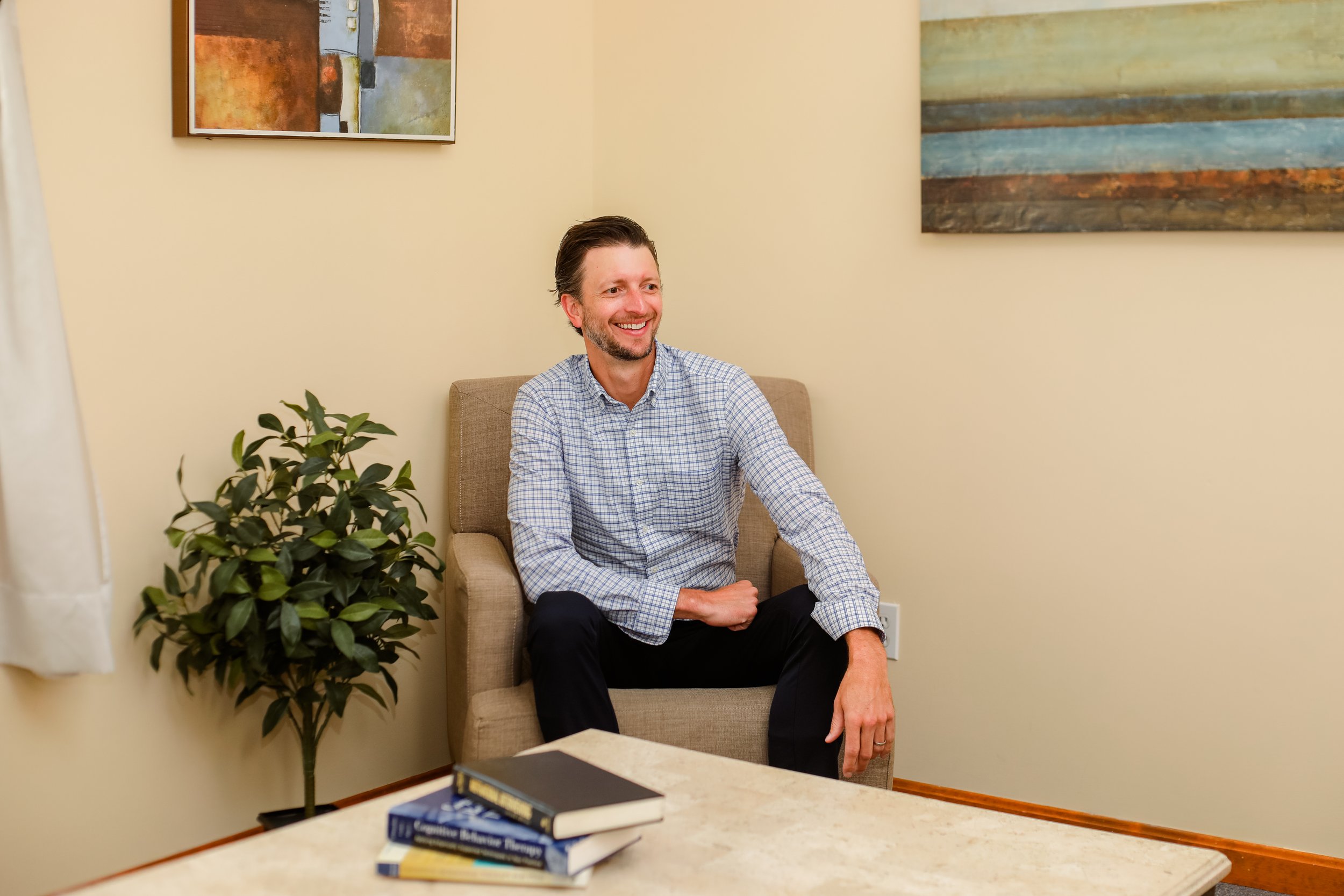
A glimpse of the office



Learn more about CBT and ACT on the blog


Is your anxiety keeping you from seeing a therapist in person? Online anxiety treatment may be the answer you’re looking for. Learn more about the convenience and transformative benefits of online therapy for those struggling with anxiety.