Online Therapy for Anxiety: Does It Actually Work?
Anxiety has a way of making the very thing that could help feel impossible to reach. If you have been putting off getting support because driving somewhere, sitting in a waiting room, or explaining everything to a new therapist feels like too much right now, that makes complete sense. And it is exactly why online therapy for anxiety exists.
In this article, I want to walk you through how online anxiety treatment actually works. Here is what we will cover:
What is online anxiety treatment, and how does it work?
Who can benefit from online anxiety help?
Telehealth for anxiety: conditions we can address
What happens in an online therapy session for anxiety?
Online anxiety treatment vs. in-person therapy: key differences
How to get started with online anxiety help in Kentucky and Ohio
What Is Online Anxiety Treatment and How Does It Work?
Online anxiety treatment is therapy delivered through a secure video platform instead of in person. You connect with a licensed therapist from wherever you are most comfortable: your home, your car, or your office. The session works much like face-to-face therapy, just without the commute or the waiting room.
I have been working with people with anxiety for over 13 years, and one thing I see consistently is that the barrier to starting treatment is often the anxiety itself. The flexibility of telehealth removes a layer of that. You are not adding another stressor to your week; you are meeting me inside it.
Serving Kentucky and Ohio via telehealth
If anxiety has been making it hard to take that first step, online therapy is designed for exactly that. I offer virtual sessions across Kentucky and Ohio. No commute, no waiting room, no added pressure.
Who Can Benefit from Online Anxiety Help?
Online anxiety help is not just a convenience feature. For many people, it is what makes treatment accessible at all. In my practice, I find it works especially well for people who:
Experience social anxiety or fear of judgment that makes sitting in a therapy office feel intimidating before they have even said a word
Have panic attacks or agoraphobia that make leaving home difficult on hard days
Have a packed schedule and need therapy session times that fit around work, school, or parenting
Live in areas with limited access to mental health providers — virtual therapy closes that gap
Process better in their own space — some people open up more easily when they are in a familiar environment
Something I notice often in first sessions is how much more settled people seem when they are in their own space. They are not navigating traffic or an unfamiliar building. That calm carries into the work.
Can online therapy help with anxiety?
Yes. A 2019 meta-analysis published in the Journal of Medical Internet Research found no significant difference in anxiety symptom reduction between internet-delivered CBT and face-to-face CBT. Research consistently supports online therapy as an effective treatment for anxiety disorders.
Telehealth for Anxiety Disorders: Conditions I Can Help With
Telehealth for anxiety is effective across a wide range of anxiety disorders and mental health concerns. Anxiety does not look the same for everyone, and the treatment approach should reflect that.
Generalized anxiety disorder (GAD) — persistent, hard-to-control worry that spreads across daily life, work, health, and relationships
Social anxiety disorder — intense fear of judgment or humiliation in social situations that leads to avoidance
Panic disorder — recurring panic attacks with physical symptoms like racing heart, shortness of breath, or dizziness
Specific phobia — extreme, disproportionate fear tied to a specific object, place, or situation
Health anxiety — excessive worry about physical symptoms and illness that dominates mental bandwidth
If you are unsure whether what you are experiencing qualifies as an anxiety disorder, that is something we can figure out together. An evaluation does not require you to have a diagnosis first: it is the starting point, not a prerequisite.
What Happens in an Online Therapy Session for Anxiety?
Knowing what to expect makes it easier to actually show up. Here is how online counseling works in my practice.
Your First Virtual Therapy Session: Getting Oriented
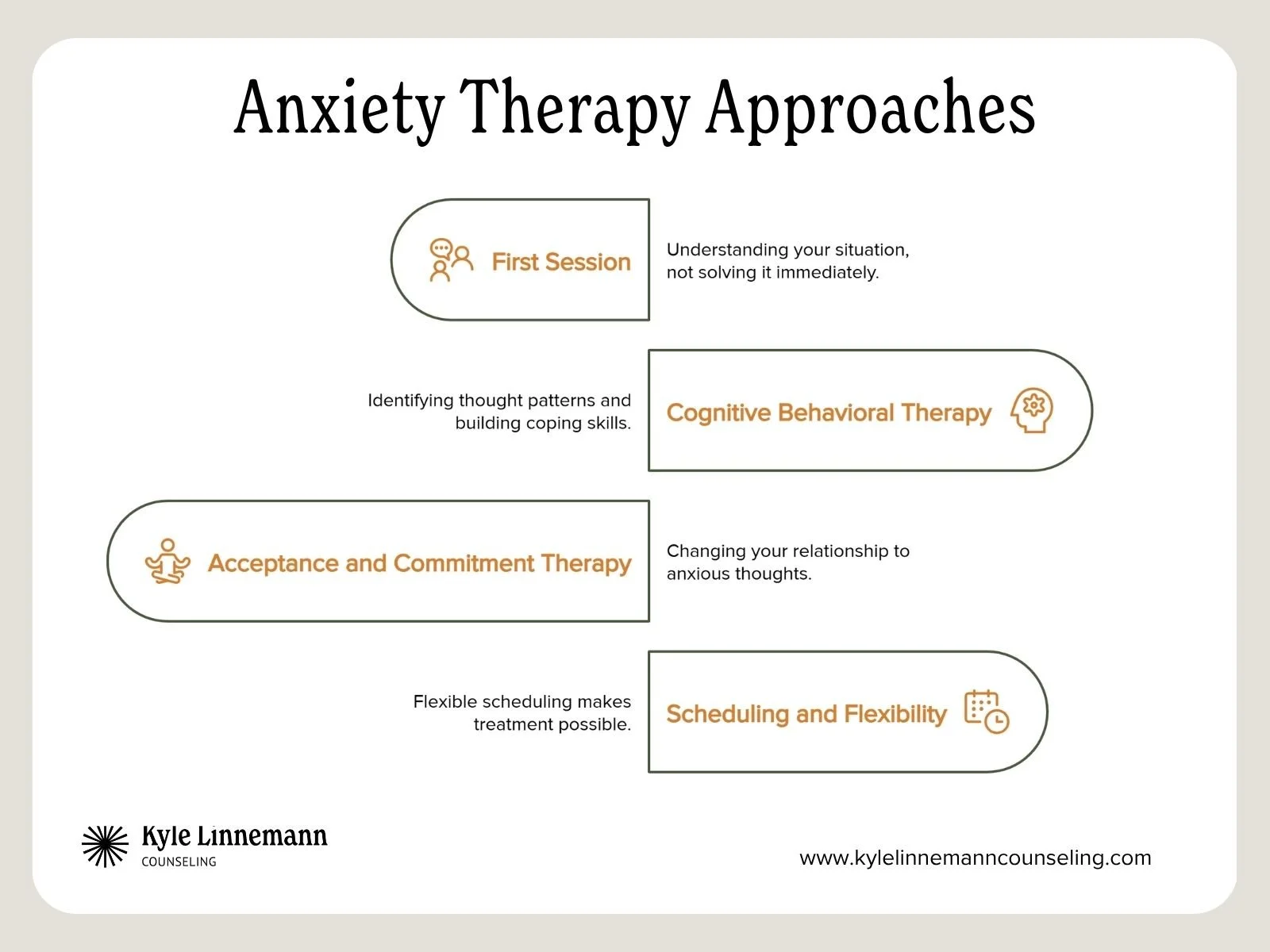
The first session is about understanding your situation, not solving it immediately. I will ask about your health history, what symptoms of anxiety you are experiencing, and how anxiety is affecting your daily life and relationships. There is no pressure to share everything at once. We move at whatever pace feels manageable.
I tell people at their first appointment: you do not have to come in knowing what is wrong. That is what we are here to figure out together. Your job is just to show up.
Cognitive Behavioral Therapy for Anxiety Online
Cognitive behavioral therapy (CBT) is one of the primary approaches I use for treating anxiety. CBT works by helping you identify the thought patterns that fuel anxiety and building practical coping skills to respond differently. The American Psychological Association recognizes it as one of the most effective evidence-based treatments for anxiety disorders, and it translates directly into the online therapy format.
Through CBT in our virtual therapy sessions, you will work on things like:
Recognizing and challenging unhelpful thought patterns that keep the anxiety cycle running
Gradually approaching avoided situations rather than pulling away; avoidance is what keeps anxiety alive
Building coping skills for managing difficult emotions in real time, including breathing and grounding techniques
Understanding the link between thoughts, feelings, and behaviors so you can start to influence that chain
How much does online therapy for anxiety cost, and is it covered by insurance?
Cost depends on your insurance coverage and plan. I work with two insurance providers: Medben and Custom Design Benefits, so online mental health care can be covered the same way as in-person therapy. If your plan does not cover telehealth, I can discuss options during our first session.
Acceptance and Commitment Therapy for Anxiety
I also use Acceptance and Commitment Therapy (ACT), particularly with clients whose anxiety is tightly wound up with questions of identity, values, and what kind of life they want to be living. Where CBT focuses on changing thoughts, ACT focuses on changing your relationship to them.
Instead of trying to eliminate anxious thoughts, ACT teaches you to observe them, hold them more loosely, and act in line with what matters to you, regardless of how you feel. I find that for many people with anxiety, this is the piece that finally moves the needle: not fighting the anxiety, but stopping it from being in charge.
One of the questions I come back to in ACT work is: what would you be doing differently if anxiety were not running the show? That question tends to open things up in ways that pure symptom-management does not.
Scheduling and Flexibility with Online Counseling
One of the most consistent things I hear from clients is that the flexibility is what finally made treatment possible. You can schedule a therapy session before work, on a lunch break, or in the evening. No factoring in travel. No rearranging your whole day.
That consistency matters more than people realize. Progress in treating anxiety comes from regular engagement, not occasional visits when things feel bad enough.
Is online therapy for anxiety as effective as in-person therapy?
Yes. Research shows that internet-delivered cognitive behavioral therapy produces comparable outcomes to face-to-face treatment for anxiety disorders. The therapeutic relationship, the techniques used, and the treatment plan are all the same; the delivery method is simply different.
Online Anxiety Treatment vs. In-Person Therapy: Key Differences
Online anxiety treatment and in-person therapy are more alike than different. The therapeutic relationship, the evidence-based treatment plan, my credentials as a Licensed Professional Clinical Counselor, and the HIPAA protections that cover every session are all identical regardless of format.
What actually differs is straightforward:
Sessions happen via secure video rather than in person in an office
You need a private space and a stable internet connection on your end
Occasional technical issues can interrupt a session — it is rare, but worth knowing
Online therapy is not the right fit for every situation. If you are experiencing a mental health crisis or need medication management alongside therapy, we will talk about what level of care makes sense, and I will help connect you with the right support. That is part of the work, too.
Ready to Find Relief? Let's Work on Your Anxiety Together
Anxiety is very good at making reaching out feel unnecessary, premature, or impossible. It convinces you that things are not bad enough yet, or that you should be able to handle it on your own, or that starting therapy is just one more thing to manage. I hear that from almost everyone who contacts me.
I want to be honest about what the first step actually looks like: you send me a message or give me a call, I ask a few questions about what is going on, and we figure out together whether working together makes sense. That is it. No commitment, no pressure, no expectation that you have everything figured out before we talk.
Whether you are dealing with constant worry that will not quit, panic attacks, social anxiety, or the kind of low-level dread that just follows you around, I am here to help you build a different relationship with it and start moving toward the life you actually want.
Anxiety does not have to keep running the show. If you are in Kentucky or Ohio and feel ready to try something different, I would genuinely love to work with you.
Other Services Offered with Kyle Linnemann Counseling
I understand you are a complex person with complex concerns. This is why I’m happy to offer a variety of mental health services to support you. You may be looking for a therapist who specializes in bereavement/grief counseling, anger management, or looking for someone to help with ACT therapy, individual relationship issues, and general depression/anxiety/stress. Regardless, I would be happy to support you. I am happy to offer further support with insurance coverage, and both in-person and online therapy in Kentucky and Ohio. Feel free to learn more via my blog, FAQ, and resources page.