How Long Does Grief Last? Understanding the Grieving Process
You may have heard that grief follows a predictable path, that it gets easier after a few weeks or months, and that you'll eventually "move on." That's one of the most common things I hear people get wrong about loss.
If you're asking how long does grief last, the honest answer is: there's no set timeline. Grief is a deeply personal experience, and how long it lasts depends on the person, the type of loss, and the support you have around you.
In this article, I'll walk you through what shapes the duration of grief, when it starts to feel more manageable, and how to know when it might be time to reach out for grief counseling.
Here's what we'll cover:
Why there's no universal grief timeline
What factors affect how long the grieving process lasts
How grief changes over time
Types of grief that can complicate or extend the process
When grief might become prolonged grief disorder
How to navigate grief and find support
Struggling with grief and wondering how to move forward?
You don't have to figure it out alone. Reach out to schedule a free 20-minute consultation.
There's No Set Timeline for How Long Grieving Lasts
Grief is unique to every person who experiences it. Two people who lose the same loved one at the same time can grieve in completely different ways, on completely different timelines. That's not a sign that one of them is doing it wrong.
Something I say regularly in sessions: grief doesn't follow a schedule. You may feel relatively okay one week and completely undone the next. That's not regression. That's just how grief works for most people.
The idea of a fixed grief timeline comes partly from the work of Elisabeth Kübler-Ross in the late 1960s. Her research was meaningful, but over time, many people came to treat those ideas as a strict roadmap. In practice, the experience of grief rarely moves in a straight line.
What we know from decades of research on bereavement is that for most people, grief softens over time rather than disappearing. The American Psychological Association describes grief as a deeply individual process involving yearning, confusion, and emotional pain that naturally shifts over time, though the pace varies significantly from person to person.
Is there a normal grief period?
There is no universally normal grief period. Most people begin to find grief more manageable within months to a year or two, but grief can last much longer depending on the type of loss, the relationship, and the support available. What matters is the direction, not the speed.
What Shapes Your Grief Timeline
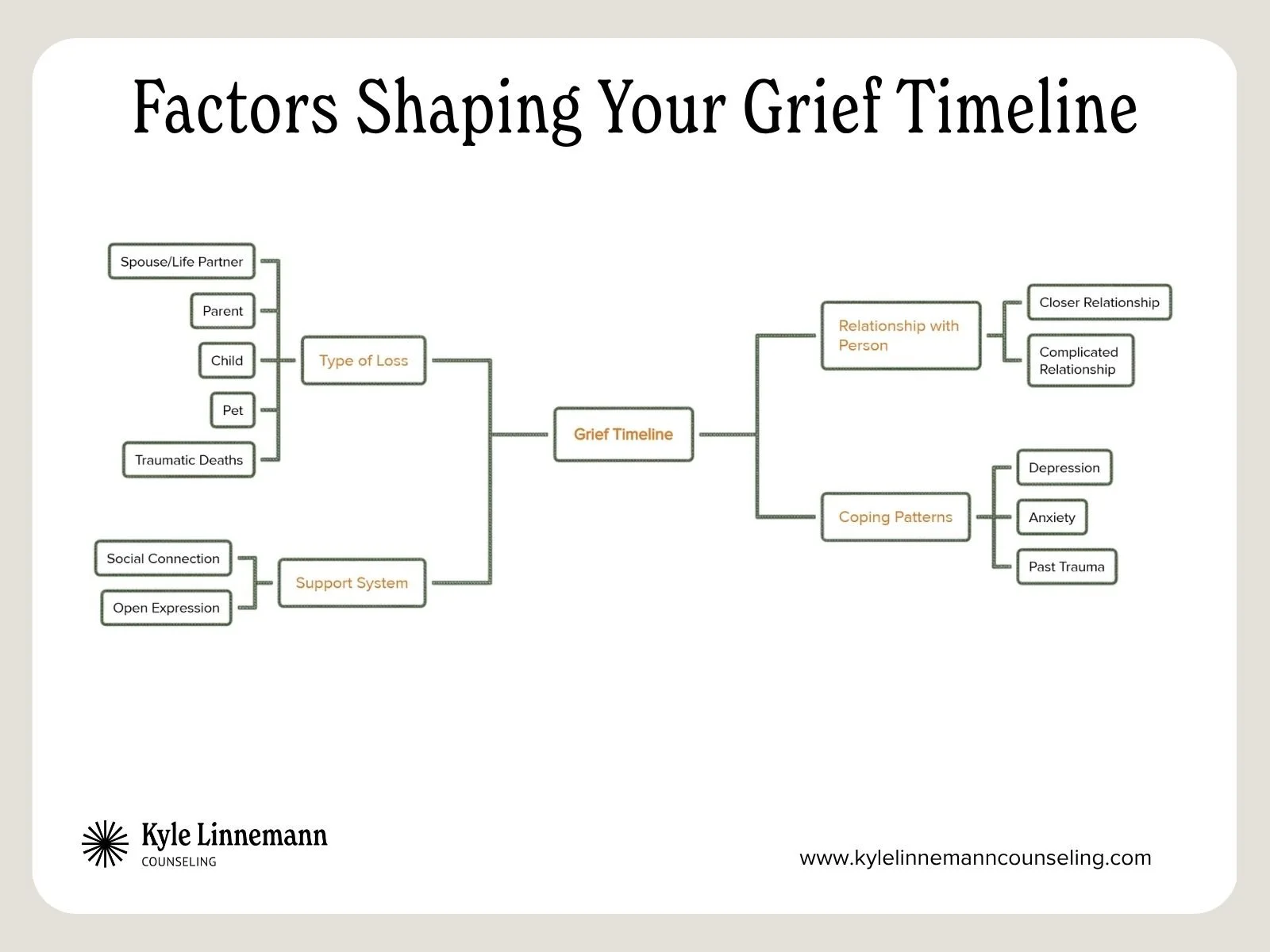
How long grieving lasts is shaped by a combination of factors, none of which are in your control, and none of which are your fault. Understanding them can help you make sense of your experience without judging it.
The Type of Loss and Grief Process Length
The type of loss matters enormously to the length of the grief process. Losing a parent after a long illness often looks very different from the sudden death of a spouse or child. The loss of a pet, sometimes dismissed as "just an animal," can be just as devastating and deserves the same compassion.
Some losses that tend to carry particularly intense grief include:
Losing a spouse or life partner: The disruption to daily identity, routine, and future plans can make this one of the most sustained forms of grief.
Losing a parent: Even when expected, the death of a parent reshapes your sense of place in the world in ways that take time to integrate.
Loss of a child: Often described as an experience that fundamentally alters a person's relationship with life itself.
Loss of a pet: The bond with an animal is real, and grief after a pet's death is valid and can be significant.
Traumatic or sudden deaths: When a loved one dies unexpectedly, grief often carries an additional layer of shock that can extend the grieving process.
Your Relationship with the Person You Lost
The closer the relationship, the longer and more intense grief can last. But this isn't always straightforward. Complicated relationships, those with unresolved conflict, ambivalence, or past harm, can actually make grief harder to process, not easier.
I sometimes see people surprised that they're grieving intensely for someone whose relationship with them was difficult. That reaction is completely understandable. Grief often isn't just about the person we lost. It's also about the relationship we wished we'd had, or the one we'll never get to repair.
Your Support System
Having people around you who can sit with your grief without rushing you through it makes a real difference. Research consistently shows that social support is one of the strongest protective factors in healthy bereavement.
According to MedlinePlus, part of the U.S. National Library of Medicine, social connection and open expression of grief are among the most important factors that support recovery after a loss.
Your Coping Patterns and Mental Health History
If you've experienced depression, anxiety, or past trauma, grief may intensify those existing experiences and extend the overall process. That's not weakness. It's simply how grief interacts with the nervous system. And it's one of the key reasons why grief counseling can be especially helpful for people who've previously struggled with mental health.
How the Grief Process Changes Over Time
Grief doesn't disappear. But for most people, it does change, and understanding how it shifts can help you recognize that you're moving through something, even when it doesn't feel that way.
The Early Weeks and Months: What Normal Grief Looks Like
In the early stages of grief, intense feelings often come in waves. You might feel shock, numbness, sadness, or a strange sense of disbelief. Many people describe functioning on autopilot in the weeks immediately following a loss.
Some people feel grief fatigue: a kind of exhaustion that comes from carrying such emotional weight while still managing daily life. That's one of the most common and least talked-about symptoms of grief in the normal grief period.
Months Later: Grief Comes in Waves
Several months into bereavement, many people find the acute intensity softens, though grief often doesn't disappear neatly. Instead, it tends to come in waves. Something ordinary, a song, a smell, a date on the calendar, can bring a wave of grief that feels just as raw as the first days.
This is normal. It's not a sign that you're going backward.
Grief Changes Over Time, But May Never Fully Go Away
One framework I find genuinely helpful, and that I share with clients, is the idea that grief stays with us, but we grow around it. This theory, known as the "growing around grief" model, was developed by Dr. Lois Tonkin. Rather than getting over your loss, you expand your life around it. The grief doesn't shrink. You grow.
That's very different from the idea that grief will never fully go away because something is wrong with you. It softens in the sense that it stops dominating every moment. But a deep love rarely leaves entirely, and that's not a problem to solve.
What not to do when grieving?
Try not to rush yourself, compare your grief to anyone else’s, or pressure yourself to “move on” before you’re ready. Avoid isolating completely, numbing the pain with alcohol or overworking, or pretending you’re fine when you’re not. Grief needs space, support, and patience.
When Does Grief Get Easier? Understanding the Normal Grief Period
Most people start to feel that grief becomes more manageable somewhere between six months and two years after a significant loss. That's a wide range on purpose, because grief is so individual.
What people often find isn't that grief disappears, but that it becomes less constant. The waves come less often, even if they're still intense when they arrive. Everyday functioning returns. You can begin to feel moments of genuine joy without immediately feeling guilty about them.
Factors That Help Grief Become More Manageable
Research and clinical experience both point to the same core factors that support healthy grief:
Connection: Having people to talk to, whether friends, family, or grief support groups, helps significantly.
Time and patience: Grief takes as long as it takes, and resisting it often extends it.
Meaning-making: Finding some way to hold what you've lost within a larger sense of meaning, through faith, ritual, service, or story, has been shown to support recovery.
Professional grief support: Grief therapy and grief counseling give you a structured space to process what you're carrying in a way that conversations with friends often can't.
Something I notice often in my practice: people who allow themselves to actually grieve, who don't push it down or stay busy to avoid it, tend to move through grief more fully than those who try to outrun it.
When Grief May Become Prolonged Grief Disorder
For most people, grief follows a course where, however slowly, it does become more manageable over time. But for some, grief remains at the same intense level long after most bereaved individuals have begun to adjust. This is known as prolonged grief disorder.
Prolonged grief disorder (previously sometimes called complicated grief) was officially added to the DSM-5-TR in 2022. According to the American Psychiatric Association, it affects approximately 7-10% of bereaved adults and is characterized by intense grief that remains disruptive to daily life for more than 12 months after the loss (or 6 months in children).
Symptoms of Prolonged Grief Disorder
You might be experiencing prolonged grief disorder if you notice several of the following for more than a year after your loss:
Intense longing for the person you lost that doesn't ease over time
Difficulty accepting the reality of the death
Bitterness or anger about the loss that feels unresolvable
Feeling that life is meaningless without the person you lost
Inability to trust others since the death
Feeling emotionally numb or detached from other people
Significant difficulty with daily functioning at work, in relationships, or with self-care
If this sounds familiar, please know: prolonged grief disorder is a recognized, treatable condition. It's not a personal failure. It's a sign that you need and deserve specialized support.
How long does grieving last after the death of a loved one?
Grief after the death of a loved one typically lasts at least several months, and for many people, the most intense period spans one to two years. Grief doesn't disappear on a set timeline. It becomes part of you, gradually growing less disruptive as you adapt and find support.
How to Navigate the Grieving Process
Navigating grief doesn't mean getting through it quickly. It means moving through it with enough support that you don't get stuck.
Coping With Grief Day to Day
There's no formula for how to deal with grief, but there are things that consistently help people carry it. Here are some starting points:
Let yourself feel it: Grief avoided tends to surface in other ways, through physical symptoms, irritability, or emotional numbness.
Maintain gentle structure: Basic routines like sleep, meals, and movement give your nervous system something to hold onto.
Talk about the person you lost: Saying their name, sharing memories, and letting others witness your grief matters.
Don't set a deadline for yourself: The pressure to "be over it" by a certain point adds suffering to suffering.
When to Seek Grief Counseling
Grief counseling isn't only for people in crisis. It's useful for anyone who wants a space to process their loss with someone trained to help. Some good reasons to reach out to a grief counselor or therapist include:
Grief that feels completely unmanageable several months in
Isolation or withdrawal from people you care about
Using alcohol or substances to cope
Inability to function at work or in relationships
Feeling like grief will never get better
Intense guilt, anger, or shame related to the loss
If any of that resonates, it's worth reaching out. You don't need to be in a full crisis to deserve support.

You Can Miss Them Deeply and Still Find Your Way Forward
Grief is one of the most common things I work with, and one of the most misunderstood. In my work with grieving clients, I draw heavily on Acceptance and Commitment Therapy (ACT), an approach that doesn't ask you to feel better or think differently about your loss. Instead, it helps you make room for the pain while staying connected to what matters most to you. The goal isn't to get over grief. It's to keep living alongside it, with more ease and more meaning over time.
If you're in Northern Kentucky or the Greater Cincinnati area, I'd be honored to sit with you in this. Reach out to schedule a free 20-minute consultation. There's no pressure and no expectation. Just a chance to talk, and to figure out together whether working with me feels like the right next step.