Coping Mechanisms in Grief: Small Steps That Make a Big Difference
Losing someone you love changes the shape of your whole life. Coping mechanisms in grief are the specific things you do, think, and practice that help you carry that loss without being flattened by it. There is no right or wrong way to grieve the death of a loved one, but there are healthy ways to cope that help you move through the pain instead of getting stuck in it.
An estimated 7 to 10% of bereaved people develop a more complicated form of grief that doesn't ease with time on its own. That number matters, not to worry you, but to make one thing clear: if your grief still feels unbearable months or years later, that isn't a personal failure. It's normal to feel sad on and off for a long time. The difference is whether that sadness is easing, even slowly, or staying frozen in place.
In this guide, we'll walk through:
What actually counts as a healthy coping strategy for grief, and what doesn't
How coping looks different depending on the type of loss you're facing
The physical, in-your-body science behind why grief hurts so much
Coping skills for kids and teens, plus how to handle the hardest dates on the calendar
How to tell when it's time to bring in professional support
If you're struggling to cope with grief right now, keep reading. You don't have to figure this out alone.
What Are Healthy Coping Mechanisms in Grief?
Healthy coping mechanisms in grief are the strategies that let you feel the full weight of a loss while still functioning, connecting with people, and finding moments of meaning. They are not about moving on, forgetting the person who died, or rushing to feel better. They are about carrying grief instead of being buried by it. Simply naming what you've lost can help you understand why grief feels the way it does.
As a grief counselor, something I say often in session is that the people who struggle most are usually the ones trying to grieve "the right way." There isn't one. Your timeline, your emotions, and your coping style will not match anyone else's grieving process, and that's entirely normal.
Grief Coping Skills vs. Coping Strategies: What's the Difference?
People use these terms interchangeably, but there's a useful distinction. A coping strategy is the broader approach you take toward your grief as a whole, such as choosing to stay connected to your support system instead of isolating. A coping skill is the specific, repeatable action you use in a hard moment, like a breathing technique or a grounding exercise you reach for when a wave of grief hits you at your desk.
You need both. Strategy gives your grieving process direction. Skills give you something to actually do when the pain shows up without warning.

There's No Right or Wrong Way to Grieve, But Here's How to Cope With Loss
Grief is a natural response to loss, not a problem to be solved on a schedule. It shows up differently depending on who died, how they died, your relationship to them, your culture, and your own nervous system. Grieving doesn't mean forgetting the person you loved, and it doesn't mean you have to feel a certain way by a certain date.
What tends to trip people up isn't the grief itself. It's the pressure to perform it correctly, to look composed at work, to stop crying by the one-year mark, to "be strong" for everyone else. That pressure is often what turns a normal, hard grieving process into something that gets stuck.
Coping Strategies for Grief by Type of Loss
Coping mechanisms in grief aren't one-size-fits-all. The circumstances of a loss shape what your nervous system needs to process it, and pretending every death asks for the same response usually leaves people feeling more alone.
Sudden or Traumatic Death vs. Long Illness
Grief after a sudden death often carries a layer of shock and disbelief that grief after a long illness doesn't. Research on bereaved adults has found that the unexpectedness of a death significantly predicts more severe grief symptoms and a higher likelihood of prolonged grief disorder, even after accounting for the relationship to the person who died.
If someone close died suddenly, in an accident, by suicide, or from a sudden medical event, your mind may replay the final hours, looking for something that could have changed the outcome. That's a normal trauma response layered on top of grief, and it usually needs to be addressed as both.
Anticipatory Grief: Coping Before the Loss
Anticipatory grief is the grieving process that begins while someone is still alive, usually during a terminal diagnosis or a long decline. Coping strategies here look different because you're managing dread, caregiving fatigue, and loss all at once, often while trying to stay present for the person who's still here.
Pregnancy Loss and Pet Loss: Grief That Often Goes Unacknowledged
Some losses don't get the social recognition they deserve, which makes coping harder, not easier. Miscarriage occurs in an estimated 10 to 20% of known pregnancies, yet many people are told to move on within days, often before they've told anyone they were pregnant at all.
The loss of a pet follows a similar pattern. The bond was real, but the outside world may not treat it as a legitimate loss worth grieving openly. This pattern has a name: disenfranchised grief. I cover it in more depth in what disenfranchised grief is and how to cope with hidden loss, including why the absence of a funeral or public acknowledgment doesn't make the grief any less valid.
Why Grief Feels Physically Painful
Grief hurts in your chest and stomach because your brain processes emotional loss using some of the same circuitry it uses for physical pain. Neuroimaging research has found that the same brain regions activated by physical injury, including the anterior cingulate cortex, also light up during intense grief, which is part of why loss can produce very real chest tightness, fatigue, and a hollowed-out feeling in the body.
UCLA researchers found that grief also activates the brain's reward centers, since your brain has built years of neural pathways expecting that person to be reachable. Every time you instinctively reach for the phone to call them, or expect them to walk through the door, your brain is essentially getting a prediction error. That mismatch, played out thousands of times, is exhausting on a purely biological level.
Something I remind clients of often: the fatigue, the brain fog, the appetite changes. Those are not signs you're handling grief poorly. They're signs your brain and body are doing exactly what they're built to do after a major loss.
Healthy Emotional Grief Coping Skills
The most effective emotional coping skills help you process what you're feeling instead of pushing it aside. These are the approaches I recommend most often to clients navigating the loss of a loved one.
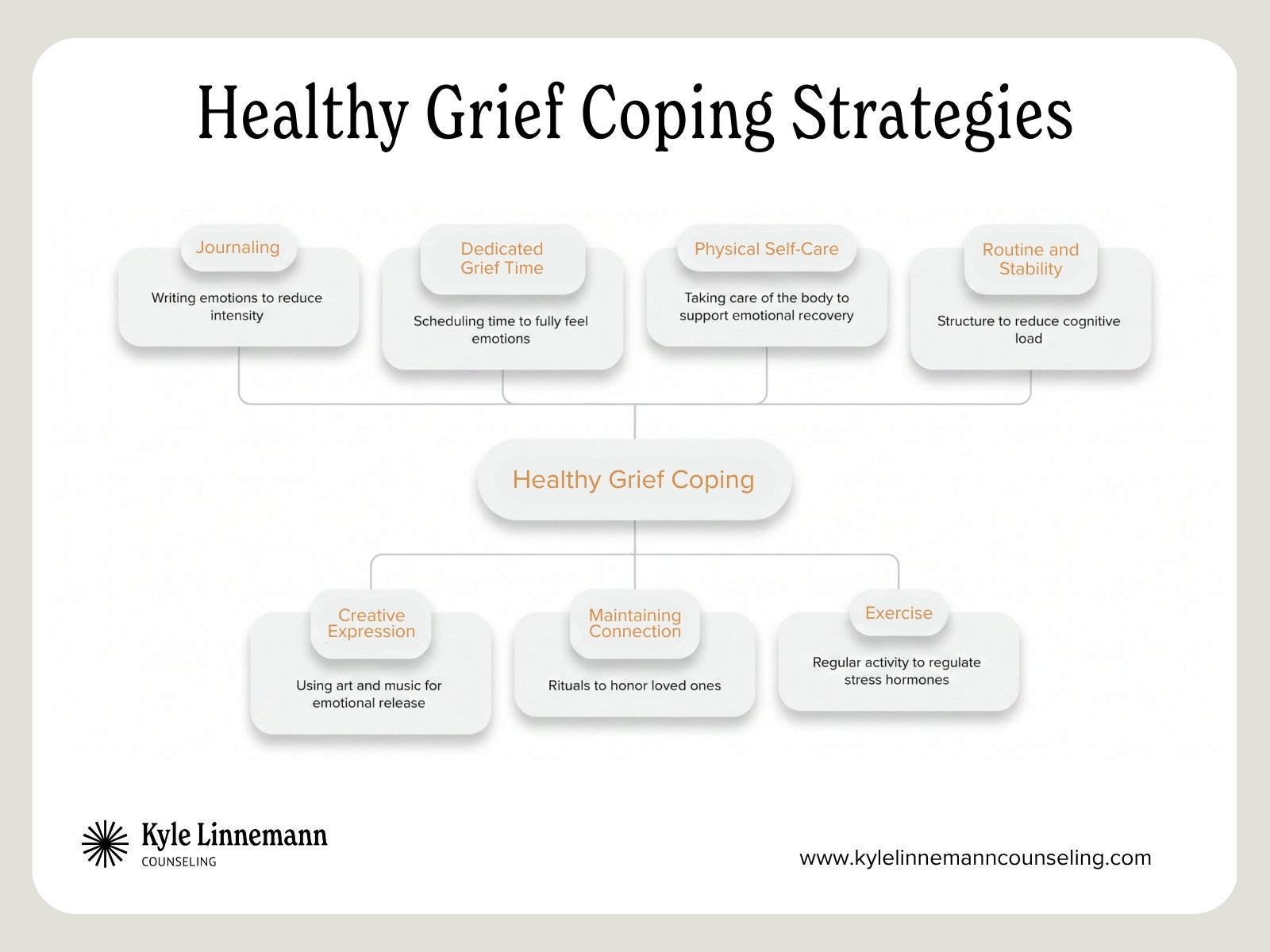
Journaling: One of the Most Accessible Grief Coping Techniques
Journaling is one of the most accessible grief coping techniques available. Writing about your emotions externalizes them, which can reduce their intensity and help you gain perspective over time. You don't need to write well or at length. Even five minutes of unfiltered writing a day can shift how you feel.
Try writing about the person you lost: a memory, something you miss, an inside joke only the two of you understood. Letting grief onto the page gives your emotions somewhere to go when talking feels like too much.
Creative Expression and Processing Grief
Art, music, movement, or storytelling gives grief a place to land when words fall short. Many people find that drawing, painting, or simply listening to meaningful music lets emotions surface in a gentler, less confrontational way. You don't need to be artistic to benefit. The goal isn't a finished product. It's the release of something that needs a way out.
Dedicated Grief Time
One of the most counterintuitive coping strategies for grief is deliberately scheduling time to grieve. Setting aside 20 to 30 minutes at a consistent time, maybe after dinner or before bed, gives your grief a container. You allow yourself to feel whatever comes up fully during that window, and when grief intrudes at other moments in the day, you can acknowledge it and tell yourself, "I have time for this later."
Maintaining Connection After Loss
Grief doesn't require severing your bond with the person who died. Many people find real comfort in small rituals that maintain that connection: cooking a favorite recipe, visiting a meaningful place, keeping a photograph nearby, or planting something in their memory. These acts of remembrance aren't signs of being stuck. They're a healthy part of how people carry love forward.
What are healthy coping mechanisms for grief?
Healthy coping mechanisms include journaling, creative expression, maintaining routine, physical activity, staying connected to supportive people, and allowing yourself dedicated time to feel your emotions instead of suppressing them.
Physical Self-Care for Grief Recovery
Physical self-care matters because loss takes a real toll on the body. Grief can disrupt sleep, suppress appetite, weaken immune function, and drain energy for weeks or months. Taking care of your physical health isn't a distraction from the emotional work of grieving. It's what keeps you capable of doing that work at all.
Exercise: One of the Healthy Ways to Cope With Grief
Regular physical activity is one of the most reliable healthy ways to cope with grief. Even a short daily walk helps regulate the stress hormones that grief elevates, releases physical tension, and improves sleep quality. You don't need to overhaul your fitness routine. A 15-minute walk, a gentle yoga session, or a few minutes of stretching each morning counts. Consistency matters more than intensity.
Routine and Stability During the Grieving Process
A simple, consistent daily routine provides structure when grief has destabilized everything else. Waking at the same time, eating regular meals, and going to bed at a reasonable hour reduce the cognitive load of loss and create small anchors throughout the day. When you're grieving, predictability is a form of safety, and safety is what allows deeper emotional processing to happen.
It's also worth being thoughtful about alcohol and caffeine right now. Both can worsen anxiety, disrupt sleep, and blunt the emotional processing grief recovery depends on. Alcohol, in particular, is a depressant, and it tends to deepen the weight of grief rather than lighten it.
What Are Unhealthy Coping Mechanisms for Grief?
Unhealthy coping mechanisms are strategies that offer short-term relief but worsen your well-being over time. The most common ones I see in practice include:
Using alcohol or substances to numb emotional pain: This temporarily blunts feelings but delays processing and often deepens depression over time.
Complete emotional avoidance: Staying constantly busy or refusing to think about the loss prevents the normal grieving process from unfolding.
Isolating from your support network: Withdrawing from friends and family removes the scaffolding that grief recovery depends on most.
Performing a "brave front" for others: Suppressing your emotions to protect people around you often backfires into emotional exhaustion.
Setting a rigid timeline for healing: Telling yourself "I should be over this by now" adds shame to an already painful experience, and shame is one of the biggest obstacles to healthy grieving.
Compulsively checking a deceased loved one's phone or social accounts: A small amount of this is normal, but using it to avoid accepting the loss can keep grief frozen in place.
None of these responses makes you a bad person. They're understandable reactions to unbearable pain. But recognizing them as unhealthy is the first step toward replacing them with coping skills that actually support healing instead of delaying it.
Grief Coping Strategies for Children and Teens
Children and teens grieve differently from adults, often in bursts rather than a steady wave, playing one minute and sobbing the next. An estimated 8.9%, or roughly 1 in 11 children, will experience the death of a parent or sibling before turning 18, which makes childhood grief far more common than most families realize.
What Helps Kids Cope With Grief
Kids need simple, honest language rather than euphemisms like "went to sleep" or "passed away," which can create confusion or fear. They also need permission to keep being kids: to play, to laugh, and to ask the same question about death more than once as their understanding develops.
Keep routines predictable. School, meals, and bedtime staying consistent helps a child's nervous system feel safe enough to process the loss.
Offer concrete outlets. Drawing, a memory box, or a simple journal gives children a way to express grief they may not have words for yet.
Watch for delayed or disguised grief in teens. Irritability, withdrawal, or a drop in grades can be grief wearing a different mask.
Include them in remembrance, age-appropriately. Letting a child help choose a photo or write something for a service supports healthy grieving rather than shielding them from it entirely.

If you're parenting through your own grief while also supporting a grieving child, know that you don't have to hide your sadness completely. Children learn how to grieve by watching the adults around them do it honestly and safely.
Coping During Grief-Heavy Dates and Anniversaries
Birthdays, holidays, and the anniversary of a death often bring grief back with an intensity that can feel like a setback, even years later. This is a normal reaction, sometimes called an "anniversary reaction," and it doesn't mean your grieving process has failed.
Ways to Cope With Grief-Heavy Dates
Plan the day instead of dreading it. Decide in advance whether you want company, solitude, or a specific ritual, rather than letting the day catch you off guard.
Build in a small act of remembrance. Lighting a candle, cooking their favorite meal, or visiting a meaningful place can turn a hard date into an intentional one.
Give yourself permission to feel two things at once. You can genuinely enjoy a holiday gathering and still feel the absence sharply. Both are true at the same time.
Tell the people around you what you need. Most people want to support you but don't know how; a simple heads-up removes the guesswork.
Navigating Grief in the Digital Age
Grief now happens partly online, and that comes with its own set of coping challenges. A deceased loved one's social media profile, photos, and old messages remain accessible indefinitely, which can be a comfort or a source of ongoing pain depending on the day.
Research on bereaved Facebook users has found that visiting a memorial profile can help maintain a continuing bond with the person who died, offering a sense of ongoing connection similar to visiting a grave. For many people, this is a healthy part of processing grief.
Healthy Ways to Cope With Digital Reminders
Decide intentionally, not automatically. Notice whether visiting their profile brings comfort or spirals you into distress, and let that guide how often you go there.
Consider memorializing the account. Most platforms let you convert a profile into a memorial page, which stops jarring notifications like birthday reminders while preserving the page itself.
Be thoughtful about posting your grief publicly. Sharing openly can bring support, but comparing your grieving process to how others mourn online can add pressure that isn't helpful.
Watch for avoidance disguised as connection. Constantly rereading old messages to avoid accepting the loss is different from occasionally revisiting them for comfort.
Building a Grief Support Network
Connection is one of the most powerful coping strategies for grief available to anyone. Isolation may feel protective when you're in pain, but it tends to amplify grief rather than reduce it. Building even a small network of supportive people can make an enormous difference in how grief moves through you.
You don't have to articulate your grief perfectly to the people around you. Simply telling someone you trust, "I'm struggling today," opens the door. Most people who care about you want to help; they just don't always know how. Giving them something specific to do, sitting with you, listening without fixing, or bringing a meal helps both of you.
For many people, grief support groups offer something individual relationships can't always provide: the experience of being understood by someone who truly knows what loss feels like. Hearing that others have felt the same guilt, anger, or unexpected relief can be deeply normalizing. Support groups are available in person and online throughout Northern Kentucky and the greater Cincinnati area.
What helps with the grieving process?
For many people, it helps to talk about what they're feeling, lean on supportive friends or family, keep a gentle routine, and allow themselves to grieve in their own way and time.
When Grief Needs More Than Self-Help
Grief that feels as intense at the one-year mark as it did in the first weeks after a loss may have moved into what's known as prolonged grief disorder, and there is no shame in needing professional help beyond what self-help strategies can provide. Consider reaching out for professional grief support if you notice:
Grief that hasn't softened at all after 12 months or more
Significant difficulty functioning at work, in relationships, or with daily tasks
Reliance on alcohol, substances, or other unhealthy behaviors to get through the day
Persistent guilt, worthlessness, or hopelessness that won't lift, sometimes a sign of unresolved grief from this loss or an earlier one
Thoughts of self-harm or of not wanting to be here
Feeling completely alone even when people are physically present around you
Wondering how long grief usually lasts is one of the most common questions I hear in session, and the honest answer is that it depends on many factors: the relationship, the circumstances of the death, and the support available to you. There isn't a finish line, but there is a point where compassionate, evidence-based grief therapy can help you carry it differently. If you're struggling, I'd be glad to walk through this with you. Reach out to schedule a session.
Ready to Stop Carrying This Alone? Here's How We'd Work Together
I've been fortunate to undergo extensive training in Prolonged Grief Treatment (PGT) with Dr. Bonnie Gorscak, a key leader in grief and loss who has worked closely with Dr. Katherine Shear over the last 20 years.
As a grief counselor, I use PGT to create a safe, supportive space to help you understand and work through what's holding you back from adapting to your loss.
We'll face those challenges together and build a life that still holds meaning and joy, alongside the grief rather than instead of it. If what you've read today resonated with you, reach out to schedule a free consultation, and let's figure out together what healing could look like for you.