To help someone with depression, start small. Listen, tell them you care, and gently point them toward support. Let's be honest: supporting someone you love can be tiring. Many people want to help but don't know how, and that's okay. Your own limits and sleep matter here too.
The short answer: Listen without judging and tell them plainly that you care. Encourage professional help and check in regularly. Learn the crisis steps: call or text 988, or call 911 in an emergency. And look after your own rest and support. Small, steady actions count for more than perfect words.
You're not alone in this. You don't need perfect words, just a calm, caring presence and a few simple things to try. Below are scripts, a list of what to say and what to avoid, a plan for when they refuse help, and ways to look after yourself while you learn how to support someone with depression.
Why It's Hard to Know How to Help (and Why Your Presence Still Matters)
It's hard because depression changes how a loved one talks, acts, and responds, and you're afraid of saying the wrong thing. That fear shows you care. It doesn't mean you'll make things worse.
Depression can feel like walking down a staircase, with each step making the climb back harder. Each step down makes the next one harder to climb back from. Low energy can lead to reduced activity, which may deepen feelings of depression. That's why small steps matter. A short walk or one honest conversation can be the first step back up.
Depression is a mental health condition, not a weakness or a choice. Major depressive disorder, also called clinical depression, is one form of depression that can significantly affect mood, energy, thinking, and daily functioning, according to the National Institute on Aging. Like any mental illness, it isn't something a person can simply decide to stop feeling.
Why Listening Without Judgment Is a Skill
Listening without judgment is a skill you can learn. It isn't a personality trait. It means letting the person talk without rushing to solve, correct, or cheer them up. Repeat back what you hear ("That sounds exhausting"), ask open questions, and let silences happen.
This helps you, too. When your job is to listen rather than solve, you don't have to have all the answers. Being there is the help.
Signs Your Friend or Loved One May Be Struggling
A friend or family member may be struggling if you notice lasting changes in their mood, energy, or habits. Treat these as signs to pay attention to, not reasons to jump to conclusions. Here's what to look for:
Low mood, sadness, or a sense of emptiness that doesn't lift
Pulling away from friends, family, or activities
Sleeping much more or much less, or changes in appetite
Losing interest in things they used to enjoy
Irritability, tiredness, or trouble focusing
Hopelessness or harsh talk about themselves
Not every symptom shows up in every person. The National Institute of Mental Health notes that some people experience only a few symptoms, while others experience many.
Grief can look very similar. After a loss, sadness, poor sleep, and pulling away are normal parts of grieving. A qualified mental health professional can help assess whether someone is experiencing grief, a depressive disorder, or both. For a fuller picture, this guide to common symptoms of depression goes deeper.
If any of this feels familiar, you don't have to sort through it by yourself.
Reach out to schedule a session with me and talk through what you're carrying.
Get in touch todayHow to Start the Conversation: Word-for-Word Scripts for Helping a Friend With Depression
The easiest way to start is with a simple, honest observation and an open invitation. If you're working out how to help a friend with depression, or wondering what to say to someone with depression in that first moment, these scripts give you a place to begin. Change the words so they sound like you.
5 Scripts You Can Use Today
Opening: "I've noticed you seem down lately. I care about you. Want to talk?" Use it the first time you raise it, in a calm and private moment.
Checking in: "Just thinking of you. No need to reply, but I'm here." Use it between conversations, or when they've gone quiet.
Offering company: "I'm going for a short walk. Want to come? We don't have to talk." Use it when they're pulling away.
Asking what helps: "What would make today a little easier? Even something small." Use it when you want to help but aren't sure how.
After they open up: "Thank you for telling me. That sounds really hard. I'm glad you did." Use it right after they share something.
Body Language and Setting
Choose a calm, private time when neither of you is in a hurry. Side-by-side activities, such as driving or walking together, can feel less intense. Put your phone away, keep your posture open and relaxed, and speak gently. Say the word "depression" plainly if it fits. Talking openly can help reduce feelings of shame.
What not to say to someone with depression?
Avoid phrases that play down their pain, compare it to something worse, or hurry them along, such as telling them to cheer up or think positive. These can feel dismissive, even when you mean well. Instead, acknowledge what they feel: "That sounds really heavy. I'm here." The Instead of / Try list above gives seven swaps you can use right away.
What to Say to Someone With Depression (and What Not to Say)
The most helpful things to say acknowledge how someone feels without trying to talk them out of it. Phrases that play down the pain, compare it to something worse, or hurry the person along can sound like "your pain doesn't count," even when you mean them kindly. People with depression may already feel misunderstood, so those words can leave them feeling more alone.
Instead of: "Just get over it." Try: "That sounds really heavy. I'm here." Why it helps: It names how heavy things are instead of rushing past it.
Instead of: "Snap out of it." Try: "You don't have to have it all figured out right now." Why it helps: Depression is a health condition, not a choice.
Instead of: "You're overreacting." Try: "It makes sense that you feel this way." Why it helps: Accepting their feelings builds trust.
Instead of: "Just think positive." Try: "Want to tell me what today's been like?" Why it helps: It invites honesty instead of pretending.
Instead of: "It could be worse." Try: "I'm sorry it's this hard right now." Why it helps: Comparisons can minimize someone's pain, while empathy helps build connection. Sympathy connects you.
Instead of: "Call me if you need anything." Try: "I'm bringing dinner Thursday. Is six okay?" Why it helps: A specific offer is easier to accept.
Instead of: "Everyone gets sad sometimes." Try: "I'm not going anywhere." Why it helps: It offers steadiness instead of comparison.
If they say something like "I feel so guilty for being like this," don't argue them out of it. Accept it and acknowledge it instead: "It sounds like you're carrying a lot of guilt. That's a hard feeling. I'm still right here with you." Arguing can leave them feeling unheard. Acknowledging the guilt helps them feel less alone with it.
How to Support Someone With Depression Day to Day
Day-to-day support is mostly small, steady, practical help that makes hard days easier to cope with. Here are some things to try:
Listen without judgment whenever they want to talk.
Offer practical help, like meals, errands, or a ride to an appointment.
Check in regularly. A short text counts.
Invite them for a short walk together.
Be patient with slow progress and setbacks. Hard weeks are part of the road, not a failure.
5 simple coping skills to try together:
Gentle movement: a 10-minute walk counts.
A simple routine: regular times for waking up and eating.
A steady sleep schedule: the same bedtime most nights.
Reaching out: sending one text or making one call each day.
Small, doable tasks: one dish, one email, one shower.
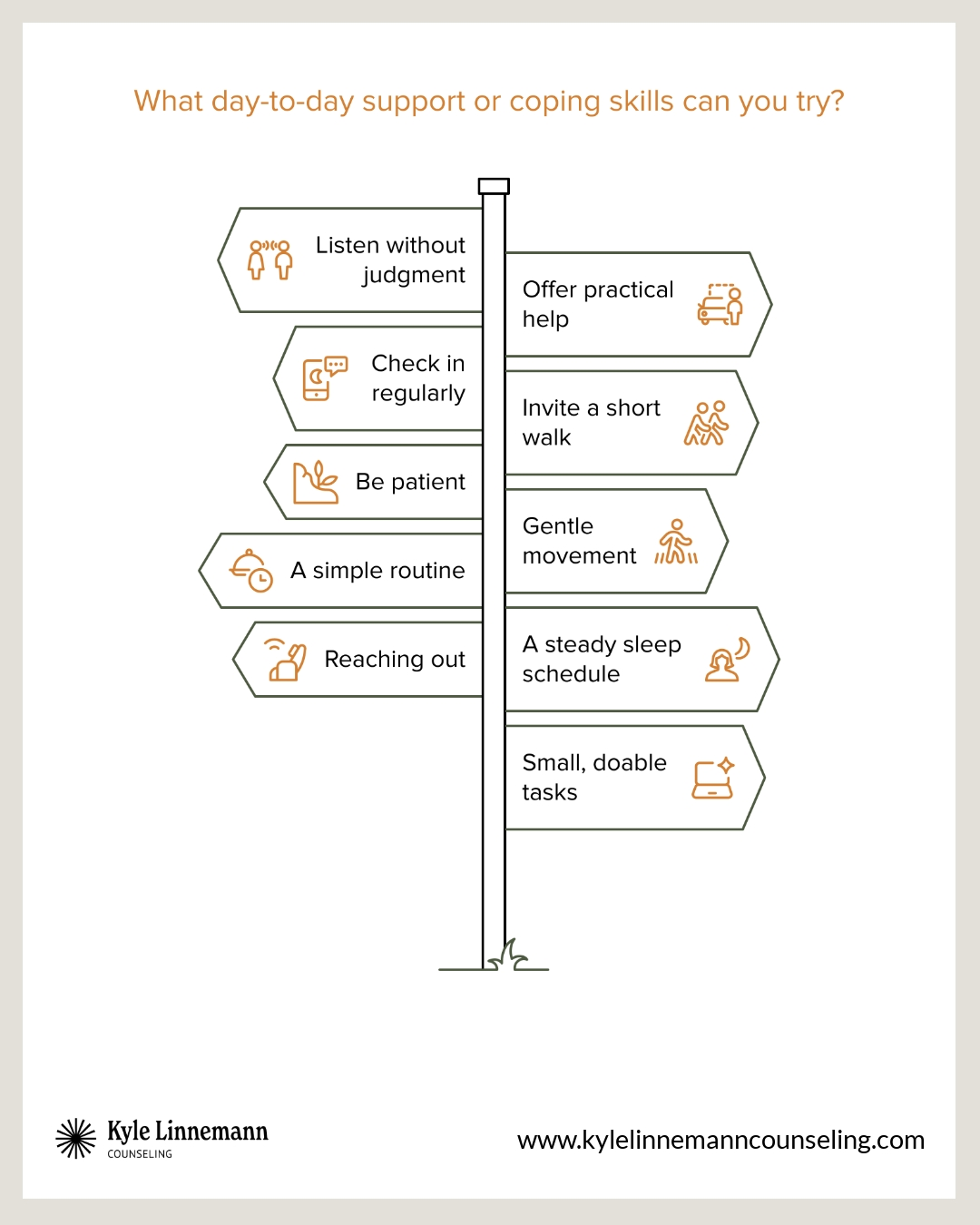
Offer these as invitations, not assignments. Doing them alongside the person can make them easier.
Encouraging Professional Help Without Pushing
One way to encourage professional help is to frame seeking support as a strength and offer to make it easier. NIMH advises that if you see signs of depression in someone you know, encourage them to seek help from a mental health professional. Reaching out is a strength. It doesn't mean something is broken.
Practical offers make the first step smaller. You could help search for a counselor or a local behavioral health clinic, sit nearby while they call or book online, or drive them to the first appointment. A visit to their regular doctor is another good place to start.
It may help to explain what to expect. A first session usually begins with a conversation about what's been going on and what they'd like to change, with no pressure to share everything. It's confidential and protected by HIPAA, a federal privacy law that keeps health information private.
Many counselors use Cognitive Behavioral Therapy (CBT), a practical approach that connects thoughts, feelings, and actions. Another common approach is Acceptance and Commitment Therapy (ACT), which helps people make room for hard feelings while moving toward what matters to them. For a local example, here's an overview of depression treatment in Erlanger.
Professional help isn't only about easing symptoms. Over time, it can help a person reconnect with what gives life meaning, and that can be true for the helper as well.
Normalizing Therapy With Kids and Teens
How you talk about counseling shapes how kids and teens see it. Present it as a strength: "Seeing a counselor is like having a coach for your feelings. Lots of people do it." Never frame it as a punishment. You can show them it's normal by talking openly about your own stress, or by sharing your own experience if you've seen a counselor yourself. Let them help choose someone they feel comfortable with.
What to Do When They Refuse Help
If they refuse help, stay connected and keep the door open rather than pushing harder. Depression can drain hope and energy, which may make someone reluctant to seek help. Here are five steps:
Don't argue. Pushing harder can make them dig in.
Ask what worries them. It might be cost, time, stigma, or fear of not being understood.
Offer smaller steps. A regular doctor visit or an online session can feel easier.
Keep inviting, gently. Bring it up again every few weeks, without pressure.
Stay connected. Keep up the texts, meals, and walks.
A script for refusal: "Okay, I hear you. I won't keep pushing. If you ever want help finding someone, I'll sit with you while you look."
Sometimes a refusal comes with signs that things are getting worse, like not eating, staying in bed for days, increased alcohol or drug use, or talking about hopelessness or death. If that happens, get help even if they say no. Talk with a doctor, a counselor, or another trusted family member, and use the crisis steps below.
How to help with depression if they won't talk?
Stay present without pressing for a conversation. Offer company that doesn't need talking, like a drive, a show, or a quiet walk. Try other ways of reaching them, such as texts that don't need a reply. Keep making small invitations and let them know the door stays open. If things seem to be getting worse, talk with a professional yourself.
Helping a Partner, Parent, Teen, Friend, or Coworker
How you support someone depends on your relationship with them. A few short tips:
Partner: When they pull away or snap at you, it usually isn't about you. Try not to take it personally, and keep some shared routines going.
Teen: Depression may show up as irritability, anger, or slipping grades. Stay close, and involve the other parent and the school counselor.
Parent or older adult: The NIA notes that depression is a common problem among older adults, but it is not a normal part of aging. Gently suggest they mention their mood to their doctor.
Friend: Keep inviting them, even when they say no.
Coworker: Speak privately and respectfully, and never gossip.
Men: Depression may show up as anger or withdrawal rather than sadness.
Long-Distance Support by Text, Call, and Video
You can comfort someone from far away with steady, low-pressure contact. Three tips:
Pick a rhythm, like a short text most mornings.
Offer choices: text, call, or video, whichever feels easier.
Send messages that don't need a reply.
Sample texts:
"Thinking of you today. No need to write back."
"Saw this and thought it'd make you smile. Miss you."
"Want to watch the same show tonight and text through it?"
If You're Worried About Suicide: Clear Steps to Take
If someone is in immediate danger, call 911. Do not leave them alone. For urgent support, call or text the 988 Suicide & Crisis Lifeline, a suicide prevention line open any time of day or night.
Warning signs to take seriously:
Hopelessness, or feeling there's no way forward
Saying they're a burden to others
Giving away things that matter to them
Saying goodbye in ways that feel final
Ask directly and calmly: "Are you thinking about suicide?" Asking does not plant the idea. A research review in Psychological Medicine found that "acknowledging and talking about suicide may in fact reduce, rather than increase suicidal ideation."
Ask directly, and listen calmly to the answer.
Stay with them, or arrange for someone to check in regularly.
Remove or lock away anything they could use to harm themselves, if it's safe to do so.
Call or text 988 together to talk with a trained crisis counselor.
Call 911 if they are in immediate danger.
What are 5 coping skills for depression?
Five simple coping skills to try are gentle movement, like a 10-minute walk; a simple daily routine; a steady sleep schedule; reaching out to one person each day; and small, doable tasks that build a sense of progress. These work best as gentle invitations, not demands, and many people find them easier to do with someone else.
Taking Care of Yourself While You Support Someone
Caring for yourself is part of helping someone. It isn't a break from it. Supporting someone through depression is draining, and your limits are real. Here are some things to try:
Set kind boundaries: "I can talk until nine, and then I need to sleep."
Share the load: bring in other friends or family so it doesn't all rest on you.
Protect your sleep: try a 10-minute reset before bed, a set time to turn your phone off, and one check-in window each day.
Take breaks without guilt.
Your own mental health matters too. Needing support yourself is not a burden. Caregivers can also benefit from counseling, which offers a place to process some of what they've been carrying.
Whenever You’re Ready, Depression Counseling Is Here
You don’t need perfect words to help someone with depression, and looking after yourself is part of helping. If you or the person you’re supporting wants a counselor to talk with, I’m here.
I’m a Licensed Professional Clinical Counselor (LPCC) in Kentucky and Ohio, with a Master of Arts in Mental Health Counseling from the University of Cincinnati and more than 13 years of clinical experience. I use CBT and ACT, and I offer in-person sessions in Erlanger for people across Northern Kentucky, plus online sessions for clients in Kentucky and Ohio. Depression Counseling is for both the person who is struggling and the helper who feels worn down. If grief is contributing to the heaviness, Grief Counseling is also available.
Sessions are confidential and HIPAA-protected. As a next step, call 859-760-6743, email kyle@griefcounselingnky.com, or send a short form through the website to set up a free, no-pressure first conversation.
This article is for general information only. It is not a substitute for professional care or emergency services. If someone is in danger, call 911 or call or text 988.