Academic Anxiety: What’s Really Going On Beneath the Stress
If you’re seeing anxiety creep into your child’s schoolwork, you’re not alone. Many students experience academic anxiety, and it often shows up long before grades drop or test performance suffers. Large-scale studies on student mental health consistently show a strong relationship between anxiety and academic performance, especially in performance situations like tests, presentations, or speaking in front of peers. This type of anxiety isn’t a lack of effort. It’s a physiological stress response. Or, put another way, your child’s brain did not download the “calm during exams” update.
In this article, we’ll explore:
What academic anxiety actually is
Why academic pressure often causes anxiety
How anxiety affects students’ academic performance
How parents can help manage academic anxiety
If your child is struggling with academic anxiety or school stress, support is available. You don’t have to navigate this alone.
What Is Academic Anxiety and Why It Shows Up
Academic anxiety refers to persistent stress and fear connected to academic tasks, not just everyday school stress. It includes:
test anxiety
pressure around grades
fear of falling behind
This is more than “feeling nervous.” Research links higher anxiety levels to measurable changes in attention, working memory, and performance in academic settings, especially during tests and evaluations.
Importantly, anxiety lives in the nervous system, not just in thoughts. When stress and anxiety spike, the body shifts into threat mode. Heart rate increases, muscles tense, and thinking becomes more rigid. That physiological response explains why anxiety and performance often have an inverse relationship. Studies consistently show that high anxiety is associated with lower academic success, even among capable students, including college students with strong study skills.
Can Academic Pressure Cause Anxiety? (Yes, and Here’s Why)
Academic pressure often starts outside of us and slowly moves in. Well-meaning parents, teachers, advisors, and academic systems tend to emphasize performance, outcomes, and “success,” assuming motivation will follow. For many individuals, especially adolescents and college students, that pressure turns into fear and anxiety. Over time, perfectionism and fear of failure become survival strategies. Doing well stops being about learning and starts being about not messing up.
Higher levels of academic pressure are associated with higher anxiety levels, more avoidance, and increased symptoms of anxiety and depression. Anxiety may temporarily push effort, but beyond a certain amount of anxiety, performance begins to decline. More pressure does not equal higher performance.
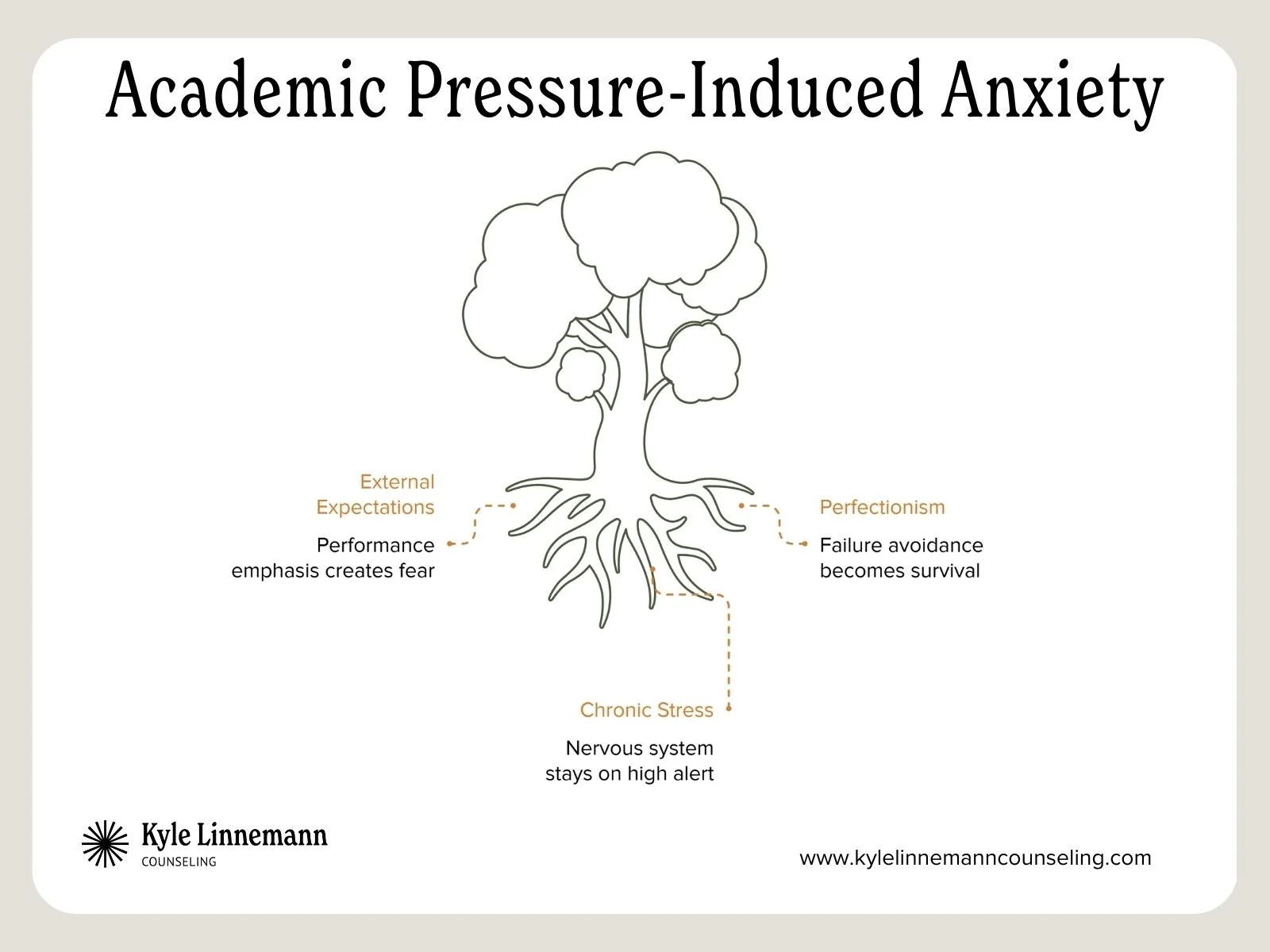
The Nervous System Under Chronic Academic Pressure
Under chronic academic stress, the nervous system learns to stay on high alert. The brain reads exams, deadlines, and evaluations as threats, triggering fight, flight, or freeze responses. That can look like overstudying, procrastination, mental shutdown, or physical symptoms such as headaches or nausea.
Over time, anxiety shows up faster and more intensely, even when the actual academic demands have not changed. Understanding these different mechanisms helps explain why managing anxiety is not about “trying harder,” but about helping the nervous system feel safe enough to re-engage with learning opportunities.
How Anxiety Affects Students’ Academic Performance
Anxiety has a direct impact on how the brain functions during academic tasks. When anxiety spikes, working memory shrinks, processing speed slows, and attention narrows. This helps explain why capable, prepared students suddenly “blank” during exams or struggle to recall information they know well. It is not a knowledge problem. It is a nervous system problem.
Students who experience high anxiety often report:
Difficulty concentrating or staying focused
Trouble recalling information under pressure
A sharp drop in motivation despite strong effort
The Anxiety-Avoidance Loop
Avoidance is one of anxiety’s favorite coping strategies. Skipping an assignment or delaying schoolwork brings short-term relief, but the relief is temporary. Over time, avoidance increases anxiety levels and creates more academic stress. Avoidance is associated with poorer performance and increased feelings of overwhelm.
Common anxiety-driven behaviors include:
Procrastination mistaken for poor time management
Missed assignments linked to anxiety, not laziness
Withdrawal from classes, exams, or academic advising
Why More Pressure Rarely Fixes the Problem
When students feel overwhelmed, adding pressure usually backfires. Higher pressure often increases anxiety and stress, rather than improving outcomes. Telling an anxious student to “just try harder” raises anxiety measure scores and worsens performance. Or as I like to put it, yelling “calm down” has never calmed anyone down.
The most effective strategies help students manage their anxiety first, so learning can follow.
What causes academic anxiety and school stress?
Academic anxiety is often caused by performance pressure, fear of failure, and high expectations related to schoolwork.
How to Deal With Anxiety Without Turning Home Into Test Prep Boot Camp
When a child is struggling with anxiety related to schoolwork, the instinct is often to jump into problem-solving mode. Fix the grades. Fix the study habits. Fix the outcome. The challenge is that anxiety disorder symptoms are not fixed through pressure. They’re regulated through safety.
One of the most helpful things a parent can do is become a calm nervous system for their child. Anxiety is contagious. Calm is too. Supporting does not mean removing all discomfort, but it does mean responding to anxiety symptoms without reinforcing avoidance. The goal is to reduce anxiety negatively interfering with learning, not eliminate anxiety entirely.
Practical Ways Parents Can Help with Academic Anxiety
Research linking anxiety and academic achievement shows that emotional responses at home shape how anxiety shows up in academic settings. Helpful strategies include:
A few practical ways parents can help:
Validate feelings without validating fear.
You can acknowledge that your child feels anxious without agreeing that something bad is about to happen. Saying “That sounds really stressful” helps far more than “You’re right, this test is terrifying.”

Encourage effort, persistence, and flexibility over results.
Focusing only on grades or outcomes can unintentionally raise anxiety. Shifting the conversation toward effort, learning, and trying again sends the message that mistakes are part of growth, not something to fear.
Reduce catastrophic language around performance.
Statements like “This will ruin everything” or “This matters more than anything” often increase anxiety, even when said casually. Calmer, more balanced language can help your child’s nervous system settle enough to actually engage with the work.
This approach helps lower anxiety scale scores over time and supports academic achievement more effectively than pressure-based strategies.
Model calm problem-solving.
When stress shows up, talk through next steps slowly instead of reacting emotionally. This shows your child that challenges can be handled piece by piece.
Keep routines predictable during stressful periods.
Consistent schedules around homework, sleep, and downtime provide stability when academic pressure increases.
Praise coping, not just achievement.
Noticing moments when your child faces anxiety, asks for help, or sticks with something difficult reinforces resilience more than praising outcomes alone.
Teaching Kids to Work With Anxiety, Not Against It
Anxiety is information. It signals perceived threat, not actual danger. Managing anxiety helps prevent it from being detrimental to academic progress. Teaching kids to work with anxiety builds long-term emotional regulation, flexibility, and resilience. With the right mental health resources, anxiety becomes something they can cope with, rather than something that runs the show.
How do you cope with academic anxiety?
You cope by learning how anxiety affects your performance and by practicing strategies that help you manage it. When anxiety is better understood and supported, it has less control over how you show up during tests and academic challenges.
When Academic Anxiety Is a Sign to Get Extra Support
Some amount of anxiety around school is normal. But there is a point where the level of anxiety starts to interfere with daily functioning and learning. When anxiety becomes chronic, it is associated with lower academic performance, increased avoidance, and emotional distress across academic factors.
Common signs that academic anxiety may need extra support include:
School refusal or frequent absences tied to distress
Physical complaints like headaches, stomachaches, or nausea with no medical cause
Emotional meltdowns or shutdowns around schoolwork
Perfection paralysis, where fear of failure prevents starting or finishing tasks
When reassurance stops helping, anxiety is no longer just situational. At that point, anxiety also begins to affect motivation, confidence, and the ability to cope with normal academic demands. Many individuals with anxiety show rising anxiety measure scores even when academic expectations stay the same.
Why Therapy Can Help When Parenting Tools Aren’t Enough
Therapy is not a last resort. It is skill-building. Students using structured therapeutic strategies experience improved emotional regulation and better academic outcomes over time.
In therapy, students learn how to cope with anxiety by understanding their emotional responses and practicing strategies for managing stress before it overwhelms them. This goes beyond fixing test anxiety or study skills deficits. The focus is on long-term emotional tools that support learning, flexibility, and resilience.
Helping students develop these skills early improves their ability to manage anxiety across future academic and life challenges. With the right support, anxiety no longer has to dictate performance or limit growth.
What does academic anxiety look like?
It often shows up as procrastination, test anxiety, overwhelm, or trouble focusing on schoolwork. Anxiety among students is usually related to pressure, not ability.
Anxiety Treatment That Helps You Breathe Again
My approach to anxiety counseling is grounded in both Cognitive Behavioral Therapy (CBT) and Acceptance and Commitment Therapy (ACT). CBT helps you understand the patterns that keep anxiety going, while ACT focuses on building flexibility so anxiety has less control over your life.
We start by understanding how anxiety works, not trying to eliminate it. Learning why anxiety shows up and how avoidance keeps it alive creates real change. From there, we focus on practical skills like breathing, gradual exposure, and mindfulness to help you respond differently when anxiety appears.
The goal isn’t perfection or eliminating anxiety completely. It’s learning to move toward what matters, even when anxiety is present, and building skills that support you far beyond academics. Reach out today to learn how anxiety counseling can help you move forward with more confidence and less fear.