Why Perfectionism Isn’t Helping You (And What Actually Will)
You know that quiet panic before hitting “send”? The urge to rewrite the same sentence three times, or the late-night replay of something you said hours ago? That’s perfectionism at work, whispering that “good enough” isn’t really good enough.
At first glance, perfectionism can appear to be discipline or high standards, but underneath, it’s often fueled by a fear of failure, inadequacy, or the belief that one's worth depends on flawless performance. According to a study by the American Psychological Association (APA), socially prescribed perfectionism, the belief that others expect you to be perfect, has increased by over 33% among college students since the 1980s, linking it to rising rates of anxiety, OCD, and eating disorders.
In this article, we’ll explore:
What perfectionism really is and what causes it
Why perfectionism isn’t helping you (and how it turns maladaptive)
The “all-or-nothing” trap and the link to low self-esteem
How to overcome perfectionism and find peace in imperfection
If you’ve been caught in the cycle of perfectionistic striving, know this: you’re not alone, and there’s a way to loosen perfectionism’s grip so you can live more freely.
What Is Perfectionism?
At its core, perfectionism is a personality trait marked by relentless self-criticism, the pursuit of unrealistic standards, and a constant sense of falling short, no matter how much you achieve. While it can sometimes look like ambition or striving for excellence, perfectionism often comes from anxiety, not inspiration. It’s about control, safety, and the quiet hope that being “almost perfect” might finally make you feel “enough.”
Psychologists describe perfectionism as multidimensional, meaning it takes different forms. Common types of perfectionism include:
Self-oriented perfectionism: placing high expectations on yourself, often tied to worth or identity.
Other-oriented perfectionism: holding others to impossible standards, which can strain relationships.
Socially prescribed perfectionism: believing that everyone else expects you to be flawless, a pressure that can feel crushing.
While some forms of perfectionism can be adaptive (like healthy motivation or organization), research shows that maladaptive perfectionism, driven by fear of failure, all-or-nothing thinking, or feelings of inadequacy, is strongly linked to anxiety disorders, depression, and obsessive-compulsive disorder (OCD).
Here’s where it gets tricky: a perfectionist may appear calm and capable but is often battling intrusive thoughts about mistakes, endless procrastination, and the pressure to perform. Perfectionism can lead to stress and burnout, and when unchecked, it can become a mental health disorder that impacts daily life, relationships, and self-esteem.
The truth? Perfectionism isn’t a strength; it’s a shield. And learning to relax perfectionistic tendencies isn’t about giving up your goals; it’s about letting go of the constant fear that you’re never quite enough.
What is the root cause of perfectionism?
Perfectionism often develops from a mix of personality traits, early experiences, and learned beliefs. It can grow out of fear of failure, conditional approval, or environments where love and success felt tied to achievement.
What Causes Perfectionism?
If you’ve ever wondered why you feel such a strong need to be perfect, you’re not alone, and you didn’t just wake up one day with it. Perfectionism is often shaped by a mix of early life experiences, personality traits, and the culture we grow up in. Over time, these influences can quietly form a pattern where your worth feels tied to what you achieve, not who you are.
Let’s look at some common roots:
Early family dynamics. Research using the Family Almost Perfect Scale shows that children raised in homes with high expectations or conditional love are more likely to internalize self-critical perfectionism. When love feels earned through performance, mistakes can feel dangerous.
Personality traits. Studies on the Big Five personality traits link perfectionism with conscientiousness, sensitivity, and neuroticism, traits that make someone more prone to perfectionism but also to anxiety and depression.
Modeling and learned behavior. Kids observe. Children and adolescents who see parents being overly critical of themselves, or expecting flawless performance, learn that imperfection is “bad.”
Trauma and shame. For some, unhealthy perfectionism grows as a protective strategy after trauma or chronic criticism. It becomes a way to prevent rejection: “If I’m perfect, I’ll be safe.”
Cultural and social pressure. The modern world celebrates performance and productivity. Social media fuels physical appearance perfectionism and socially prescribed perfectionism, where approval depends on maintaining an image of success.
Over time, this cycle of perfectionism can lead to procrastination, burnout, and even illness, emotional or physical.
The takeaway? Perfectionism can sometimes start as protection, but it often becomes a prison. Understanding its roots is the first step toward loosening its hold and finding a gentler way to relate to yourself.
Why Is Perfectionism Bad? (The Hidden Costs of High Standards)
We often praise perfectionism as a sign of dedication or success. After all, who doesn’t want to do things well? But in therapy, and in life, it quickly becomes clear that perfectionism can also be deeply exhausting. The truth is, it’s not a strength; it’s a stress response.
While adaptive perfectionism (healthy motivation, care, and follow-through) can support growth, maladaptive perfectionism, the kind driven by fear and self-criticism, often leads to emotional burnout, strained relationships, and even physical symptoms.
Here’s what the hidden costs often look like:
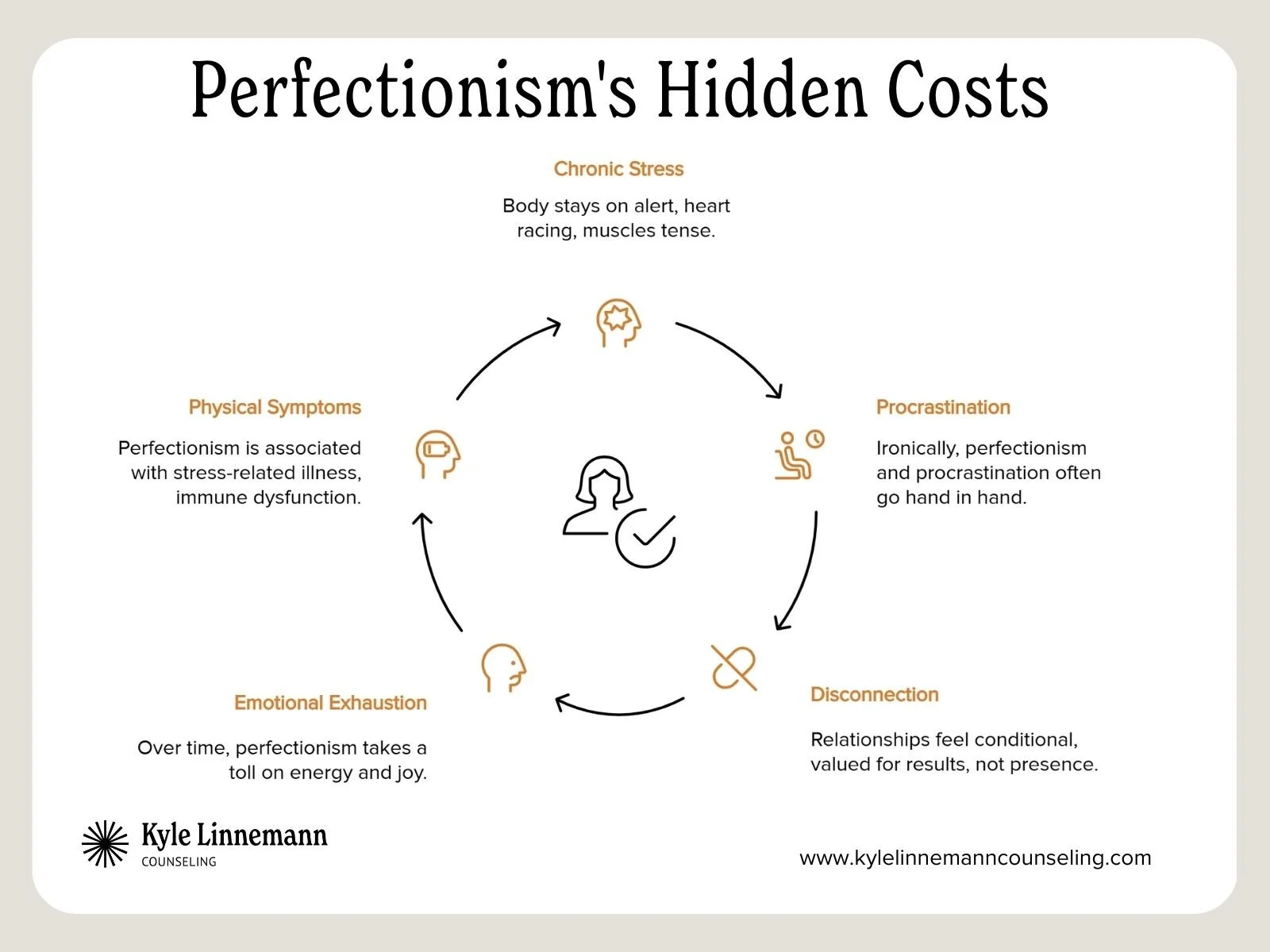
Chronic stress and irritability. The body stays on alert, heart racing, muscles tense, as if mistakes are threats.
Procrastination and paralysis. Ironically, perfectionism and procrastination often go hand in hand. If it can’t be perfect, why start?
Disconnection from others. When your self-worth depends on performance, relationships can feel conditional. People with perfectionism sometimes feel unseen, valued for results, not presence.
Emotional exhaustion. Over time, perfectionism takes a toll on energy and joy, leading to fatigue and detachment.
And the negative aspect of perfectionism isn’t limited to mood; it extends to the body. Studies show that perfectionism is associated with stress-related illness, immune dysfunction, and even increased mortality risk in severe cases.
Ultimately, perfectionism can become an avoidance strategy, a way to outrun shame, fear, and rejection. But instead of protecting you, it keeps you disconnected from yourself, your relationships, and the peace that comes from simply being human.
Letting go of the need to be perfect isn’t failure; it’s freedom.

All-or-Nothing Thinking: The Trap Behind Perfectionism
Perfectionism loves extremes. It tells you that if something isn’t perfect, it’s a failure. This is the essence of all-or-nothing thinking, a mental habit that makes life feel like one long test you can never quite pass. In therapy, I often see this pattern keeping people stuck in a loop of high pressure and low satisfaction.
This kind of thinking shows up in subtle ways:
You rewrite an email ten times before sending it.
You abandon a hobby because you’re “not good enough.”
You spend so long tweaking a project that you never actually finish it.
Sound familiar? That’s perfectionism’s trap, and it’s built on fear, not excellence.
When perfectionism whispers, “If I can’t do it perfectly, I shouldn’t do it at all,” it’s really trying to protect you from failure or rejection, but it ends up protecting you from growth instead.
Perfectionistic thinking is rigid, not realistic. It turns small mistakes into evidence that you’re not capable, when in reality, mistakes are how we learn and improve. This mindset is also linked to burnout and avoidance behaviors, since the pressure to perform flawlessly can make even small tasks feel overwhelming.
Here’s something to try: when that inner voice says, “It’s not good enough,” ask yourself:
What would “good enough” actually look like here?
What would happen if I finished this imperfectly and moved on?
What if progress mattered more than perfection?
When you begin to live in the gray areas, in the messy middle, you’ll notice something powerful. You’ll still get things done. You’ll still care deeply. But you’ll stop treating your worth like a pass/fail grade. And that’s where freedom and creativity finally start to flow.
What is a perfectionist person like?
A perfectionist tends to set unrealistic standards, hold themselves to impossible expectations, and struggle to feel satisfied, even after doing well.
Imperfection and Self-Esteem: Finding Freedom in Being Human
In the model of perfectionism, self-worth often gets tangled with performance. Perfectionism is characterized by an inner equation that says achievement = value. This link can look productive from the outside, but inside, it can feel like a quiet war against never being enough.
Studies show that low self-esteem is both a cause and consequence of perfectionistic behavior. A 2024 meta-analysis from Behavioural and Cognitive Psychotherapy found a strong link between perfectionism and self-esteem, especially when people struggle with socially prescribed perfectionism, where worth depends on others’ approval.
Here’s how perfectionism quietly erodes self-esteem:
Constant comparison. When success defines worth, someone else’s win feels like your failure.
Emotional exhaustion. The role of perfectionism in chronic anxiety means your nervous system never gets to rest.
Conditional self-acceptance. Many people with perfectionism believe they can relax or feel proud only after achieving something.
And yet, imperfection is what makes us real and relatable. In fact, perfectionism may block the very things we crave most: connection, creativity, and growth.
So here’s a gentle reframe:
What if being human, not flawless, is the point?
What if your mistakes are proof that you’re living, not failing?
What if your worth never depended on doing, but on being?
When we stop trying to be perfect, we begin to be present. That’s where real confidence and real freedom start to grow.
How to Relax Perfectionism (Practical Ways to Let Go)
If perfectionism has been running the show for a while, letting go can feel almost impossible. But here’s the truth: you don’t need to get rid of perfectionism to heal, you just need to understand its role and learn how to soften it. With awareness, you can begin to create a new model, one where peace matters more than performance.
Notice Your Inner Critic
Every perfectionist may have a familiar inner voice: the one that says, “That’s not good enough” or “You should’ve done more.” Start by noticing it. Don’t fight it, observe it.
Give it a name (“The Taskmaster,” “The Judge”) to create space between you and the thought.
When you notice the criticism, try asking, “Is this voice helping me grow or just keeping me afraid?”
Practice Compassion Over Correction
When you make a mistake, shift from judgment to curiosity.
Replace “I failed” with “I learned.”
Treat yourself with the same patience you’d offer a friend.
Self-compassion significantly reduces perfectionistic stress and protects against burnout, depression, and anxiety.
Set Realistic Goals
One of the biggest traps of self-oriented and socially prescribed perfectionism is overcommitment.
Focus on progress, not perfection.
Break tasks into manageable steps.
Perfectionism is associated with procrastination because unrealistic expectations lead to paralysis.
Challenge All-or-Nothing Thinking
Perfectionism thrives on extremes: “If it’s not perfect, it’s terrible.”
Practice finding the middle ground.
Ask, “What’s one doable next step?”
This helps disrupt the multidimensional perfectionism cycle and creates space for flexibility, something associated with resilience and emotional regulation.
Redefine Success
What if success wasn’t about flawlessness, but about alignment and peace?
Perfectionism typically ties self-worth to outcomes; try focusing on values instead.
Redefine success as balance, connection, and authenticity.
Remember: you don’t have to earn rest or joy.
Letting go of perfectionism isn’t about lowering your standards; it’s about reclaiming your freedom to grow, make mistakes, and still feel worthy.
What are the types of perfectionism?
Psychologists recognize three types of perfectionism:
- Self-oriented perfectionism: high standards for yourself
- Other-oriented perfectionism: expecting perfection from others
- Socially prescribed perfectionism: believing others expect you to be flawless
Finding Calm Beyond Perfection: How Therapy Can Help
If perfectionism and anxiety have started running your life, anxiety therapy can help you slow down, breathe easier, and regain balance.
In our work together, we’ll use a blend of proven approaches that help you understand your thoughts, calm your body, and make peace with your emotions.
You’ll learn how avoidance, though it feels helpful in the moment, actually keeps anxiety stuck. Instead, we’ll practice noticing anxious thoughts and feelings without letting them control your choices. The goal isn’t to get rid of anxiety completely, but to understand it and still move toward what truly matters to you.
Over time, you’ll build confidence and learn to face anxiety with compassion rather than fear. You’ll discover that peace isn’t about being perfect; it’s about learning to live fully, even when things aren’t flawless.
You don’t have to keep living under the pressure to be perfect. You can learn to meet anxiety with understanding instead of fear. Reach out today!