You just sent a text. Now you're re-reading it for the fifth time, wondering if it sounded needy. Your partner hasn't replied, and the silence has already spun into a story: Are they pulling away? Did I do something?
If that scene feels a little too familiar, take a breath. You're not broken, and neither is your relationship.
Here's the truth I want to lead with: relationship anxiety is incredibly common. Anxiety in general is, too. Anxiety disorders are the most common type of mental health concern in the United States, and more than 1 in 6 U.S. adults live with one. You're in good company.
In this article, I'll walk through:
What relationship anxiety actually is (and what it isn't)
How to tell anxiety apart from a genuine red flag your gut is trying to name
What causes it, including how your attachment style plays a role
How it affects both you and your partner
Practical, real-world ways to cope, including what to actually say out loud
Let's work through this together.

What Is Relationship Anxiety, Really?
Relationship anxiety is a persistent pattern of worry, doubt, and insecurity about your romantic relationship, even when the relationship itself is fundamentally healthy.
It's the worry that hums underneath, asking: Do they really love me? Are they going to leave? Am I enough? Often, when there's no real evidence that anything is wrong.
Here's what it is not. Everyone has occasional doubts. A moment of insecurity after a disagreement is normal. Wondering once whether you're compatible is normal.
Relationship anxiety isn't an isolated worry. It's the pattern, the loop that keeps returning no matter how many times you get reassurance.
And here's the piece I most want you to hold onto: much of the time, this is anxiety talking, not truth-telling. Anxiety is a convincing storyteller. It just isn't always an accurate one.
Common Signs of Relationship Anxiety
Here are the signs I see most often in my practice. As you read, notice which ones land, but go easy on yourself while you do.
Needing constant reassurance. You ask "Are we okay?" often, and the relief only lasts a little while before the doubt creeps back.
Overthinking and overanalyzing. A short reply or a slightly off tone gets dissected for hidden meaning.
Assuming the worst. A delay in a response becomes proof, in your mind, that something is wrong.
Difficulty trusting the good moments. When things are going well, part of you braces for it to fall apart.
Fear of abandonment. An underlying dread that you'll be left, even when your partner has given you no reason to believe that.
Physical symptoms. A tight chest, a racing heart, or a knotted stomach when you feel unsure about where you stand.
If several of these feel true for you, it doesn't mean something is "wrong" with you. When even one clear sign of relationship anxiety shows up, it usually means your nervous system is working overtime to protect you from a hurt it's learned to expect. That's a very human thing to do.
If you notice these worries reaching beyond your relationship and into other corners of your life, it can help to understand the different types of anxiety and how they show up in real life.
How does relationship anxiety differ from anxious attachment or relationship OCD?
They overlap but aren't the same. Relationship anxiety is general worry and doubt in a relationship. Anxious attachment is a specific pattern rooted in fear of abandonment. Relationship OCD (ROCD) involves repetitive, intrusive doubts paired with compulsive checking or reassurance-seeking. A therapist can help you sort out which one fits.
Relationship Anxiety vs. Your Gut Instinct: How to Tell the Difference
This is the question I get asked most, and it's the one almost no one talks about: How do I know if this is my anxiety or my intuition trying to warn me?
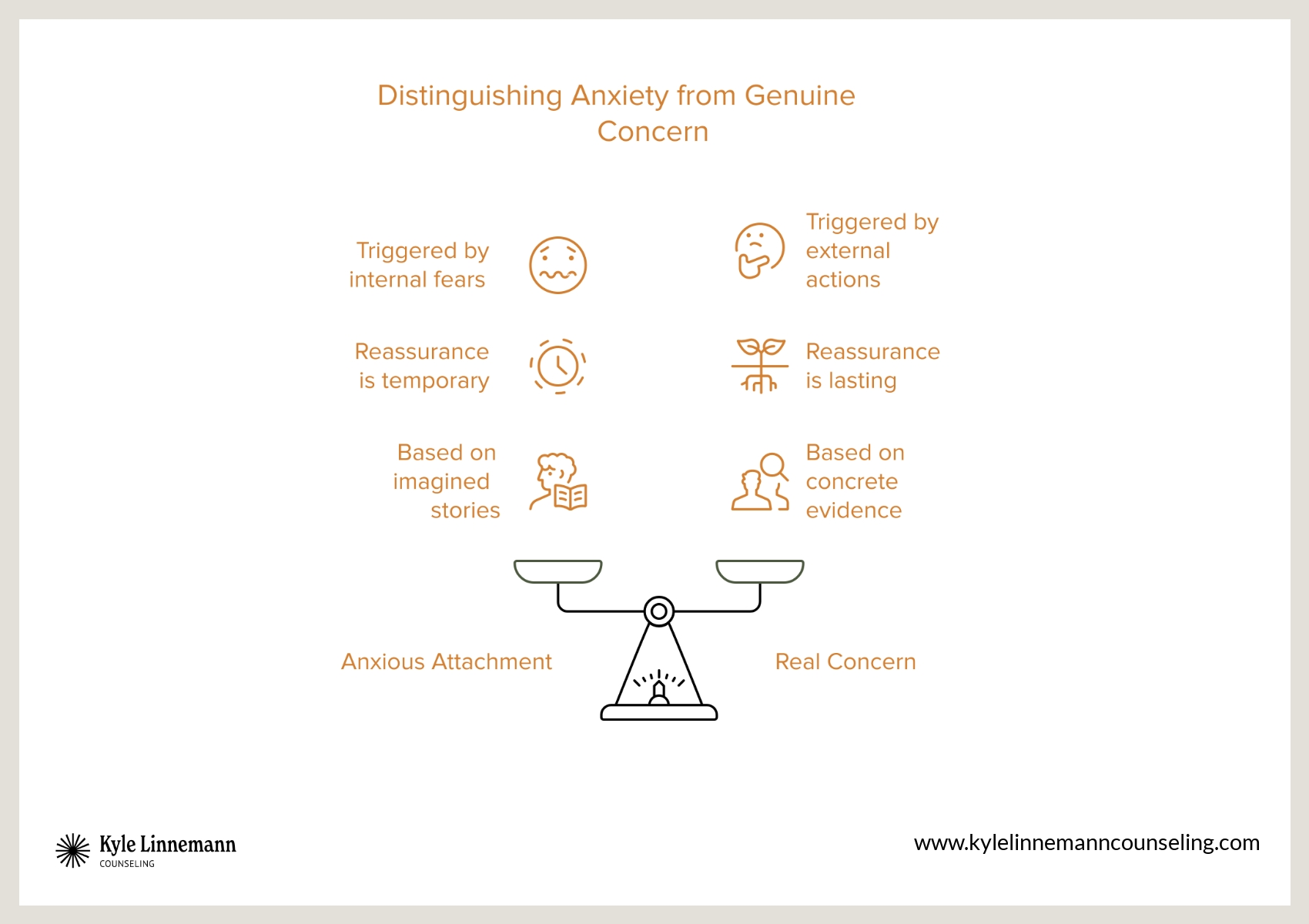
It's a fair question. Both can feel identical in your body. But they tend to behave very differently.
Anxiety usually:
Feels vague and hard to pin to a specific event
Repeats the same anxious thoughts on a loop, even after reassurance
Shows up regardless of what your partner actually does
Gets louder when you're tired, stressed, or alone at night
Leaves you seeking proof, over and over, that never fully sticks
A genuine gut instinct usually:
Points to something specific and concrete
Is tied to a real, observable pattern of behavior
Stays consistent rather than spiraling and shifting
Feels more like clarity than panic, even when it's uncomfortable
Doesn't dissolve with reassurance, because it's responding to something real
Anxiety tends to be loud, repetitive, and disconnected from actual events. Instinct tends to be quieter, steadier, and anchored to something you can actually name.
If you've struggled to tell these apart, please hear me: that's not a failing. Learning this distinction is a skill, not something you were supposed to already know. It's one of the first things I help clients build.
A Quick Self-Check for Anxious Attachment vs. Real Concern
Here are a few reflective questions I sometimes offer clients. This isn't a diagnosis or a quiz, just a gentle way to slow down and get curious about your own pattern.
Is this feeling here regardless of what my partner actually does?
Have I felt this exact worry in past relationships, too?
Am I reacting to something concrete, or to a story my mind built?
Does reassurance calm me for good, or just for an hour?
If I described this out loud to a trusted friend, would it sound like evidence or like a fear?
There are no "right" answers here. This is an educational reflection, not a clinical assessment. If it stirs something up, that's useful information to bring to a conversation with a therapist.
What Causes Relationship Anxiety?
Relationship anxiety rarely comes out of nowhere. In my experience, it usually grows from a mix of the following:
Past relationship wounds. Betrayal, a painful breakup, or being left before can teach your mind to stay on high alert.
Low self-worth. When you quietly doubt you're lovable, you look for evidence that confirms the fear.
Inconsistent early caregiving. If love felt unpredictable growing up, closeness can feel unsafe as an adult.
Generalized anxiety spilling over. Sometimes broader anxiety simply finds your relationship and settles in there.
None of these are your fault. They're patterns your mind learned in order to keep you safe. Any one of them, or several together, is something relationship anxiety could grow from, and the good news is that patterns can be understood and changed.
How Your Attachment Style Fuels Relationship Anxiety
One of the biggest drivers I see is something called attachment style, the blueprint for closeness you formed early in life, based on how dependable love felt to you back then.
People with relationship anxiety often have an anxious attachment style. They tend to crave closeness but live with a low-grade fear of being abandoned.
Research consistently links this pattern to relationships: one study found that higher levels of attachment anxiety correlate with lower relationship satisfaction. It's also associated with real distress. Surveys show that anxiously attached adults are far more likely to feel like they lack companionship (40%) than securely attached adults (12%).
Here's how anxious attachment in relationships tends to play out, a loop I watch with clients all the time:
You feel a spike of anxiety. You seek reassurance. You get it, and you feel better, briefly. Then the anxiety returns, often stronger, and the cycle begins again.
The relief never lasts, because reassurance soothes the symptom without touching the root. That's not weakness. It's just how the loop is wired, and it can be rewired.
Digital-Age Triggers: Texting, Read Receipts, and Social Media
Modern communication pours fuel on the anxious fire. A "read" receipt with no reply. A message left on "delivered" for three hours. A partner who liked someone else's photo but hasn't texted you back.
None of these mean anything, most of the time. But to an anxious mind, they're an open invitation to spiral. Anxiously attached adults are the most likely of the four attachment styles to report using social media more than six hours a day, the very environment that feeds the worry.
I often see a client stare at a screen for twenty minutes, writing three imagined reasons for a delayed reply, none of which turn out to be true. The phone becomes a slot machine for reassurance. And the house always wins.
How do I stop my relationship anxiety?
You likely won't stop it overnight, and that's okay. The most reliable path is to notice and name the anxious thought, challenge it with actual evidence, gently reduce reassurance-seeking, and communicate openly with your partner. If the pattern is persistent, working with a therapist, often using CBT and ACT, can help you get to the root and build lasting security rather than temporary relief.
How Relationship Anxiety Affects Both Partners
Relationship anxiety is rarely a solo experience. It's a dynamic, and understanding both sides matters.
For the anxious partner, the inner world is exhausting: the constant scanning, the need to check, the guilt about needing to check. It's genuinely tiring to love while bracing for loss, and that low-grade insecurity can quietly wear down your sense of intimacy over time.
For the non-anxious partner, the steady requests for reassurance can start to feel like a test they keep failing. Over time, they may feel they can never quite get it "right," which can leave them drained or withdrawn.
Here's the painful irony I point out to couples: the reassurance-seeking is an attempt to get closer, but it can quietly create distance, the exact thing the anxious partner fears most.
Please hear this clearly, whether you're the one who worries or the one who's tired: this is a dynamic to work through together. It is not a flaw in either of you.
How to Deal With Relationship Anxiety: Ways to Cope
Now for the part you came for. These are the strategies I actually walk clients through, not to make anxiety vanish overnight, but to help you manage relationship anxiety and slowly feel more secure. Try them one at a time.
If you'd like more tools beyond these, I've gathered a fuller set of coping skills for anxiety when nothing seems to help that pair well with the steps below.
Notice and name the anxious thought before you react. The moment you can say, "That's my anxiety talking," you create a little space between the feeling and your response. Naming the thought takes some of its power away.
Challenge the thought with evidence, not assumption. Ask: "What do I actually know to be true here?" Not what you fear, but what you can point to. Usually, the fear is a story, not a fact.
Build self-security independent of reassurance. Reassurance from your partner is fine in moderation, but you want your steadiness to live inside you, too. Reconnect with the parts of your life and identity that are yours alone.
Communicate the anxiety openly instead of testing your partner. Testing ("Will they notice if I go quiet?") breeds confusion. Honesty invites connection.
Limit reassurance-seeking behaviors. Notice the checking, the phone, the re-reading, the "are we okay?" Try adding a short pause before you act on the urge. You're not suppressing it, just giving it room to settle.
Practice grounding and mindfulness in anxious moments. When the spiral hits, drop out of your head and into your senses. Mindfulness simply means noticing the present moment without judging it, feeling your feet on the floor, your breath moving in and out.
What to Say to Your Partner About Your Anxiety (Without Pushing Them Away)
Talking about this can feel scary. But the way you say it makes all the difference. The goal is to own the feeling as yours rather than framing it as something your partner did wrong. That keeps them from getting defensive.
Here are a few phrasings you're welcome to adapt:
"I'm feeling anxious right now. It's not about anything you did; I just need a little reassurance."
"My mind is running a story that isn't fair to you. Can I share it so it stops feeling so big?"
"When I get quiet, it usually means I'm worried, not upset with you. I'm working on saying it out loud instead."
Notice the pattern: each one starts with "I," names the feeling, and reassures your partner they're not the enemy. That small shift lowers the temperature for both of you.
My partner has crippling anxiety. What can I do to help them?
The most helpful thing is steady, non-judgmental presence. Let them know their feelings make sense, offer reassurance without making it a test they have to pass, and try not to take the anxiety personally. It's usually about their inner fear, not you. When they feel anxious, you can gently encourage professional support, but avoid pushing.
Fear of a Relationship? When Anxiety Turns Into Avoidance
Not everyone with relationship anxiety leans in and seeks reassurance. Some people do the opposite.
For them, a fear of closeness in relationships shows up as pulling away: keeping partners at arm's length, picking fights before things get too intimate, or quietly sabotaging something good before it can hurt them.
It can look like the opposite of anxiety. But underneath, it's the same root fear: If I let you all the way in, I could get hurt. Avoidance is just a different coat over the same worry. And like reassurance-seeking, it's a pattern that can soften with support.
When to Consider Reaching Out for Support
You don't need to be in crisis to talk to a therapist. But there are a few signs that experiencing relationship anxiety may be worth reaching out about:
The distress feels persistent and hard to shake on your own
The anxiety is consistently straining your relationship
Your avoidance or reassurance-seeking patterns seem to be getting worse
You're exhausted from managing it all by yourself
Starting therapy isn't a last resort, and it doesn't mean you've failed. It's a normal, low-stakes step, a bit like seeing a coach to strengthen a skill.
If you'd like a compassionate place to start, you can learn more about working through relationship anxiety in therapy whenever the time feels right for you.
Finding Your Way Through the Uncertainty
Relationship anxiety doesn't go away by fighting the uncertainty head-on. Acceptance and Commitment Therapy (ACT) takes a different approach: rather than trying to eliminate the doubt, it helps you make room for the discomfort and keep acting in line with your values anyway.
It's an effective, acceptance-based behavioral therapy for anxiety, and research shows it can meaningfully reduce intolerance of uncertainty, which is often the exact thing keeping relationship anxiety alive.
If you're stuck in the loop of needing certainty your partner can't give you, working with a therapist trained in ACT can help you build a different relationship with that uncertainty, one where it no longer runs the show.
Wherever you are with this, I hope you feel a little more seen than when you started reading. Relationship anxiety is common, it's understandable, and it's genuinely workable. You don't have to work through it alone.