Physical Symptoms of Grief: Why Your Body Hurts Too
If your body feels like it's betraying you right now (the exhaustion that won't lift, the tight chest, the stomach that won't settle), please know that it makes complete sense. Grief isn't just emotional. It lives in the body too.
In my office, one of the first things I tell grieving clients is this: you're not broken, and you're not alone in feeling physically wrecked by a loss. What you're experiencing is real. It has a name, and it happens to so many people who are hurting the way you are.
Let's walk through this together. Here's what I want to cover:
Why grief affects the body in the first place
The most common physical symptoms of grief
What's a normal grief response, and when to see a doctor
How long these physical symptoms usually last
Gentle ways to care for your body, and where to find support
No jargon you have to decode. No "just get through it." Just a companion voice for a hard season.
How Does Grief Affect the Body?
When you lose someone you love, your body treats that loss like a threat. It kicks into a stress response, releasing hormones like cortisol and adrenaline, the same chemicals that fire up when you're in danger. That response is ancient survival wiring, not a sign that something is wrong with you.
This is where the mind and body meet. According to UCLA Health and the National Institutes of Health, the grieving process can cause everything from bodily pain and a weakened immune system to stomach upset and fatigue. Researchers trace these symptoms back to our evolutionary response to losing a social connection.
Part of what's happening is inflammation. To control inflammatory responses, your immune cells release small proteins called cytokines, which coordinate the body's reaction. During bereavement, this inflammatory response can show up as pain, gut changes, and that heavy, sick feeling. In one study of recently bereaved spouses, those with more intense grief symptoms showed enhanced inflammation compared with those who had fewer symptoms.
So if you feel physically ill, it makes sense. Your body is responding to loss the only way it knows how.
Why Grief Causes Physical Pain, Not Just Emotional Pain
Grief can create genuine physical discomfort and pain: chest tightness, a "hollow" feeling in the stomach, and aching muscles. When you're under sustained stress, your nervous system stays revved up, and your muscles hold tension, which is why heartbreak can feel so literal in the body.
Clients often tell me they feel it "in their chest" before they can put the feeling into words. That's not your imagination. That's your body carrying what your heart hasn't found words for yet.
If any of this feels familiar, you don't have to sort through it by yourself.
Reach out to schedule a session with me and talk through what you're carrying.
Get in touch todayCommon Physical Symptoms of Grief
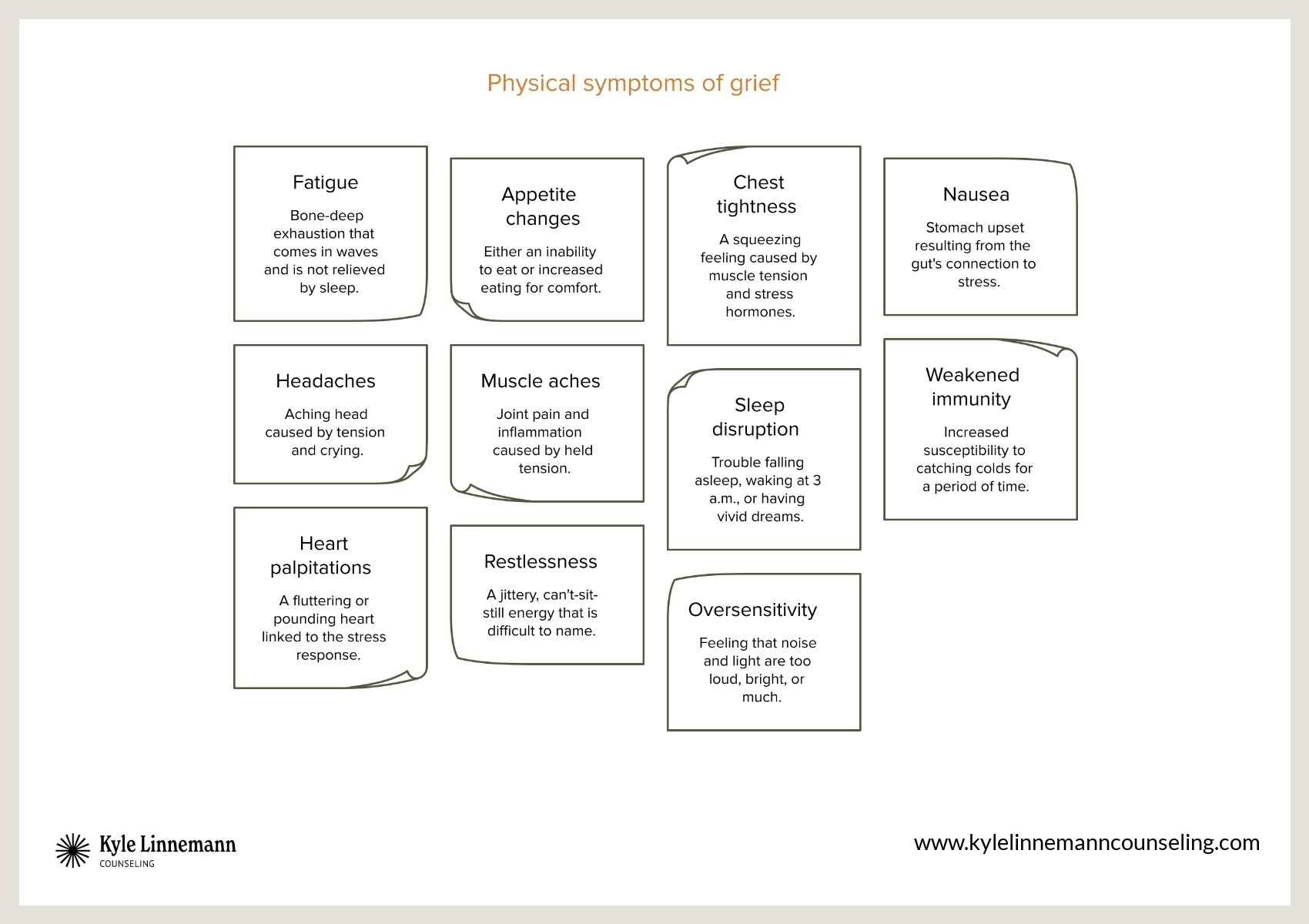
Here are the physical symptoms I see most often in clients who are grieving. Medical references note that grief can cause tightness and heaviness in the chest or throat, nausea or stomach upset, dizziness, headaches, numbness, muscle weakness, and fatigue. As you read, remember: these are common, and for most people, they ease with time.
Fatigue and exhaustion. Grief is tiring in a bone-deep way. It often comes in waves, and no amount of sleep seems to touch it.
Appetite changes. Some people can't eat; others eat more for comfort. Both are normal.
Chest tightness or pressure. That squeezing feeling is muscle tension and stress hormones at work.
Nausea and stomach upset. Your gut is deeply tied to stress, so digestion often gets thrown off.
Headaches. Tension and crying can leave your head aching.
Muscle aches and joint pain. Inflammation and held tension settle into the body.
Sleep disruption. Trouble falling asleep, waking at 3 a.m., or vivid dreams are all common.
A weakened immune system. You may catch colds more easily for a while.
Heart palpitations. A fluttering or pounding heart often comes with the stress response.
Restlessness. A jittery, can't-sit-still energy that's hard to name.
Oversensitivity to noise and light. Everything can feel too loud, too bright, too much.
Sleep deserves a special mention because it's one of the hardest parts. A large review found that bereaved individuals are at elevated risk for a variety of sleep impairments, including poorer sleep quality, trouble falling asleep, and anxious nighttime awakenings. If your nights feel broken right now, you're far from alone.
"Broken Heart Syndrome" and Chest Pain
Sometimes grief affects the heart in a very real, measurable way. There's a condition called takotsubo cardiomyopathy, also known as "broken heart syndrome" or stress cardiomyopathy, where intense emotional stress temporarily weakens the heart muscle. Because broken heart syndrome has physical symptoms similar to those of a heart attack, including shortness of breath and chest pain, you may think you're having a heart attack. However, broken heart syndrome usually doesn't cause lasting heart damage.
I'm not sharing this to scare you. I'm sharing it because it leads to the most important thing I'll say in this whole article: chest pain always deserves medical evaluation. Please don't try to figure out on your own whether your chest pain is "just grief."
Can grief make you sick?
Yes. Grief can genuinely make you physically unwell, and that's normal, not a sign of a serious underlying disease. Grief triggers a stress response that can suppress your immune system, leaving you more prone to getting sick and feeling run-down for a while. This is temporary for most people.
Normal Grief Symptoms vs. When to See a Doctor
Here's the honest tension: most physical grief symptoms are normal and will ease over time, but a few warrant a doctor's attention. Knowing the difference can lower your anxiety instead of raising it.
Fatigue. Usually normal grief. See a doctor if it's severe, unrelenting, or paired with other worrying symptoms.
Appetite loss. Usually normal. See a doctor if you're losing significant weight or unable to keep food or fluids down.
Chest tightness. Often stress-related. See a doctor right away for sudden or severe chest pain, pressure, or pain spreading to your arm or jaw.
Insomnia. Very common in grief. See a doctor if it lasts for months or leaves you unable to function.
Stomach upset. Usually normal. See a doctor for persistent vomiting, blood, or severe pain.
Heart palpitations. Often part of the stress response. See a doctor if they come with fainting, dizziness, or shortness of breath.
Please read this next line carefully: sudden or severe chest pain, trouble breathing, fainting, or any other alarming physical symptom needs evaluation by a doctor right away.
And seeking medical care doesn't mean you're grieving "wrong." It means you're taking good care of the body that's carrying you through this.
How Long Do Physical Symptoms of Grief Last?
There's no fixed schedule for grief. For many people, the most intense physical symptoms show up in the first days and weeks, then ease over several months. But it varies widely, and that's completely normal.
Sometimes grief lingers longer and more intensely. Clinicians call this prolonged grief disorder, meaning grief that stays acute and disabling far beyond what you'd expect. If your grief feels stuck this way, it can help to understand prolonged grief disorder and what makes it different.
The American Psychiatric Association notes that for most people, the symptoms of grief begin to decrease over time, and this disorder is particularly recognized when symptoms such as longing, emotional numbness, and identity disruption persist for more than a year. A smaller number of people experience grief that stays stuck.
Gently, though: if your physical symptoms stay intense for many months and feel like they're worsening rather than easing, that's worth talking to someone about. Not because you're failing, but because you deserve support.
Does grief make you tired or affect your sleep?
Yes, and grief exhaustion is one of the most common physical symptoms I see. Sleep tends to go one of two ways: you can't fall or stay asleep, or you sleep far more than usual and still wake up tired. For most people, this eases as grief softens. If it drags on for months or leaves you unable to function, that's worth raising with your doctor.
Physical Effects of Grief: Caring for Your Body While You Grieve
When clients ask what they can actually do, I keep it small and kind. This isn't homework. It's permission to be gentle with yourself.
Drink water and eat small, regular meals. Even a few bites count when your appetite is gone.
Rest without guilt. You don't have to be productive right now. Grief is work enough.
Move slowly and gently. A short walk or a few deep breaths can settle a revved-up nervous system. There's no pressure to do more.
Let yourself feel it. Anger, tears, numbness: it's all part of this. If anger surprises you, know that it's okay to be mad while you grieve.
If you'd like more ideas, here are some small coping steps that help with grief. And if your loss is still coming (a terminal diagnosis, a slow goodbye), it may help to read about coping with anticipatory grief before a loss.
When is grief the worst?
For many people, grief is most raw in the first days and weeks. But it often surges again at milestones: birthdays, anniversaries, holidays, the change of a season. If grief ambushes you months later on a meaningful date, you're not backsliding. That's just how love keeps showing up.
Grief Support: Where to Start When You're Ready
You don't have to hold all of this by yourself. Support can look like a grief support group, a trusted friend you tell the truth to, or sitting down with a therapist who gets it.
If what I've described here sounds like you, I want you to know grief counseling isn't about "fixing" you. You aren't broken. It's about having steady support while your body and heart catch up to your loss. That's it. A door you can walk through whenever you're ready, not a demand.
When and if that feels right, I offer compassionate grief counseling in Erlanger, KY. No pressure, no rush. Just a place to be met where you are. Reach out!